Search This Blog

Showing posts with label 1990. Show all posts

Wednesday, 25 October 2023

Closure of the Otago Central Railway

The Otago Central Railway was possible the longest branch line in New Zealand although it is generally referred to as a secondary railway line.  Today all that remains is the section from Wingatui (where it joins the Main South Line) to Middlemarch which is owned by Dunedin Railways, a Dunedin City Council owned Council Controlled Organisation. However, much of the remainder of the route from Middlemarch to Cromwell is now the Otago Central Rail Trail.

At its fullest extent it ran from Wingatui to Cromwell at 236km, and was cut back to Clyde in 1980 with the flooding of old Cromwell (and SH8) for the Clyde Dam, reducing its length to 214km.  Construction on the line started in 1879, it was completed in 1921.  Scheduled passenger services operated on the line until 1978, with the withdrawal of the Vulcan Railcar service, which suffered from road competition, as the route from Alexandra to Dunedin was faster by road, which was much less circuitous.  The line had long been economically marginal, and considerable freight traffic was lost with the increase of the distance limit between road and rail from 40 miles (64km)  to 150km in 1978, and most remaining general freight traffic shifted to road when the distance limit was phased out in 1983. After the Railways Corporation was formed in 1982, the Otago Central line was one of the branch lines that received direct public subsidies (called "Social Services Payments") from the Ministry of Transport, reflecting Government will to keep such lines open and paying the Railways Corporation to do so. However, with most of the line's freight in the 1980s being materials and equipment for construction of the Clyde Dam and power station, once the dam had largely been completed, it was decided to close and lift the section from Middlemarch to Clyde from 1990. 

Subsequently from Middlemarch to Clyde the route was developed into the Otago Rail Trail, and the remainder kept by Dunedin Railways for the Tairi Gorge Railway excursion trips. Perhaps had the line ever got close enough to Queenstown to support modern day tourism, the line may have had a different future.

This post has a series of articles about the end of the line and the line's history.

The first post focuses on the Otago Excursion Train Trust organising the last trip on the line and its hope to continue to operate trains on the Middlemarch section.

Last train to Clyde, Otago Central Line

This article focuses on plans by the Otago Excursion Train Trust to profitably sell the Dunedin to Middlemarch trip to tourists for scenery.


The article continues noting that Dunedin City Council paid $0.33m to acquire the line (of a total cost of $1m).  It also indicated it would pay $100,000 a year to maintain the line (half of the maintenance cost). 


The following article focuses on redundancy of railway worker Anker Hansen after 30 years working for the Railways.  He was a station agent at Lauder on the Otago Central Line initially, but was being made redundant as a train manager based in Invercargill, a job that serviced the Southerner.  The Southerner was being reduced to a five-day a week service requiring fewer train managers.  The job involved checking tickets, announcements, taking food and drink orders and serving Devonshire Teas. 

The report notes that only 31 people were travelling between Dunedin and Invercargill on the Southerner the previous Tuesday (less than a coach load).  He also noted that the booking system tended to prefer booking by coach rather than rail at the time (which was shortly before NZR Road Services was privatised  distinct from the NZ Railways Corporation). 

Anker Hanson - redundant railway worker


The next article is from the Listener, reviewing the last train trip to Clyde.  It describes the journey and some of the history along the route, and its future.


Monday, 7 August 2023

Bay Express - Hawke's Bay's last passenger rail service


Bay Express on-board leaflet

Tranz Scenic ad on the back of the leaflet


Bay Express Wine Experience package tours

Bay Express leaflet 1990 description of service and route

Bay Express leaflet 1990 description of route

The peak of Hawke's Bay passenger rail service was the Endeavour from 1972 until 1981, using refurbished 56ft first class cars in a 2-1 configuration with a full buffet car, similar to the Southerner.  The Wellington-Napier route had a service with wide comfortable reclining seats, and a sit-down full cooked meal service, giving Hawke's Bay the most comfortable regional rail service in New Zealand for decades, not to be rivalled until the most recent years of the TranzAlpine.  However, the Silverfern accident near Waiouru in 1981 saw the end of that, with withdrawal of the train to temporarily replace the badly damaged railcar from Wellington to Auckland. Hawke's Bay spent eight years with a much more austere rail service. 

From much more basically appointed 56ft cars with suburban style (old 2nd class) bench seats, to the 88-seat "grassgrub" de-engined AC class cars until metal fatigue rendered them unsafe, to modestly refurbished 56ft cars with coach type seating, none of the Wellington-Gisborne express consists would have any on-board service at all. It was the introduction of the Bay Express in 1989 that uplifted Hawke's Bay rail services to a decent level of comfort, with on-board buffet (ending the Palmerston North refreshment stop), wide scenic windows and seating competitive with coaches.  Of course the Napier-Gisborne segment, hastily added in 1981 to save on rolling stock (replacing the separate Napier-Gisborne service) was cancelled permanently in 1988 following Cyclone Bola closing the line to Gisborne, noting that patronage from Napier-Gisborne only occasionally exceeded the capacity of a bus.

The Bay Express from 1989 couldn't replicate the Endeavour because that configuration was no longer economic. A 2-1 seating layout reduced capacity by a quarter, so a more standard 2-2 configuration meant that each car could at least be about the accommodation of a road coach (notwithstanding the 56ft cars weighed three times as much), and a fully dedicated buffet car could never generate enough revenue to pay for the cost of staffing, equipping and maintaining it, and the fuel to haul it, with a train of that capacity, so a buffet bar/servery in part of a car was a reasonable compromise.  The Bay Express had many of the features of the TranzAlpine and Coastal Pacific expresses, as the NZ Rail Intercity business sought to make the route viable, it was definitely an uplift of service standards to stem and reverse the decline in patronage seen from 1981 to 1989.

The first leaflet is from 2001 in the final months of the service, the second is a 1990 publicity leaflet highlighting the service from its early days.

The Bay Express part of this leaflet has a short description of the route and a map depicting it, although not all of the towns highlighted on the route map were not stops for the train (e.g., Waipawa). Travel time was 5hrs 22min northbound and 5hrs 31min southbound.  A photo of the train on the Paremata Bridge showing the standard three-car consist is included, although often the train only operated with two cars (its final trip had five).  However, by the time of the last service, it was averaging around 45 passengers each way (although that included passengers who only travelled a portion of the route). As a result, TranzRail did not sell the service as part of the TranzScenic business at the time, and unlike the Southerner, there was no interest by the Government of the day in considering whether to subsidise the service for its tourism potential.

There is very little information about the train in the 2001 leaflet, which had on board a cafe/rear observation car.  It may be reflective of the paucity of interest by TranzRail in the TranzScenic business by 2001. 

This is a stark contrast to the second leaflet above, from 1990, shortly after the service was introduced (as a major upgrade to the austere Wellington-Napier express). The leaflet shows the full timetable with all stops, promotes visiting Hawke's Bay for wine tours, describes the onboard comfort, including Devonshire Tea from the buffet, and the observation lounge at the rear.  The stylised map includes depiction of the viaducts on the line, and a brief description of Wellington, Hastings and Napier as destinations (apologies to Palmerston North surely!). Finally a brief history of the route, describing how the service originally took over 11 hours with two changes of train. It is clear in 1990 that NZ Rail, having resuscitated long-distance services under the Intercity brand and refurbished a train to be competitive, was proud of what it had done, and was making an effort to promote the service to travellers.  

I rode the Bay Express multiple times when I lived in Wellington to visit my parents retired in Napier, so I used it regularly to spend weekends, although it meant taking a Friday off to travel and spending the Sunday afternoon returning (or sometimes taking the Monday off as well). It was always a comfortable, albeit relatively slow trip.  

Monday, 10 July 2023

Silver Fern - once New Zealand's prestige passenger rail service


Silver fern leaflet May 1982

Silver fern leaflet May 1982

Silver fern leaflet September 1982

Silver fern leaflet September 1982

Silver fern leaflet February 1984

Silver fern leaflet February 1984

Silver fern leaflet c. 1990

Silver fern leaflet c. 1990

Four sets of Silverfern (or Silver Fern?) promotional leaflets highlight some evolution in thinking about the Silverfern railcar service, which unlike many of those published here, still exists in the form of the Northern Explorer service between Wellington and Auckland (albeit with 40% fewer stops!). With withdrawal of the Silverstar sleeper train in 1979, the Silverfern was the only air-conditioned passenger rail service in New Zealand until the late 1990s when some 56ft carriages were so equipped), and certainly the only long-distance service with arguably modern rolling stock (having been built in 1972, rather than 1937-1945 or consisting of stripped down former railcars from the mid 1950s).  Until the AK class passenger cars which were progressively introduced from 2011 (for the Coastal Pacific, Tranz-Alpine and Overlander/Northern Explorer), the Silver Fern railcars were the only new long-distance passenger rolling stock from 1972. As such the Silver Fern was seen by the Railways Department and later the Railways Corporation as its most prestigious service, as the only one with double-glazing and air-conditioning. With three passenger compartments, it initially had two smoking and one non-smoking, which by the 1980s had reversed to one smoking and two non-smoking before smoking was prohibited on all passenger transport in the late 1980s. 

The Silver Fern service was the fourth evolution of daytime passenger service between Wellington and Auckland.  Pioneered by the Daylight Limited in 1925, which operated during peak holiday seasons until 1963 when

had been built on the back of the success of the Blue Streak railcar service introduced in 1968, which itself had replaced the Scenic Daylight locomotive hauled trains as the daytime Wellington-Auckland service (which had been pioneered by the Daylight Limited steam hauled trains which operated until 1960, when it was replaced by the Scenic Daylight (which ran all year). In 1963 the Scenic Daylight became diesel hauled (reducing travel time considerably), but still made multiple refreshment stops (as none of these servicing had any on-board catering). It was replaced in 1968 by the Blue Streak railcars, with limited on-board refreshment service (these being railcars refurbished for a trial, but failed Auckland-Hamilton commuter service), and was a big success.  The Silver Fern railcars were ordered new to replace the Blue Streak railcars (which were 88-seat articulated Fiat railcars that were notoriously unreliable). 

The first leaflet in 1982 was quickly supplanted by a new one, which saw photographs replaced with stylised drawings on the front page of presumably a target market of older leisure travellers rather than the younger couple actually photographed on board in the first leaflet. However, the poetic imagery on the leaflet reflects similar authorship to that of the Northerner leaflets, highlighting being insulated against noise or dust, with "wall-to-wall carpet" and that you have "all of the comforts of home" on "one of the world's finest railcars". NZR was not holding back in extolling the virtues of the service! 

The second and third leaflets are more poetic calling Kapiti Island "The Island of Romance" (before it was just a bird sanctuary) and a focus on the central plateau scenery before "Untamed scenery reluctantly yields to the seemingly interminable back yards of homes and industries bordering the track. You drift into Auckland - one of the largest sprawling cities in the world. Never more than one seat from a window, you have travelled through the real New Zealand - guided by the Silver Fern."

The actual service on board is noted for getting better in the 1990s compared to the early 1980s.  In the 1980s morning and afternoon teas, beverages and free newspapers were the peak of on-board service, with the leaflet oddly not mentioning the 25 minute long lunch stop at the Taihape railway refreshment room  (an experience I had when I was 13, but I can't honestly fully recall the meal - I think it was sausages and chips, but can't confirm).  The restructuring in the late 1980s of long-distance passenger rail services, that saw the end of subsidies after a lump sum of capital funding, meant the Silverfern railcars could offer on-board lunches served at the seat (airline style) saving time (and the expense of the Taihape railway refreshment room). 

It seems quite a service that the guard could organise a taxi or rental car at your final destination if you had an "early word", especially in an era before mobile phones (they didn't appear till 1987), it would have been reliant on the NZR's own telecommunication network, based on a private telephone network that connected stations. 

The 1982 leaflets include the "Wednesday express" which was NOT the Silverfern, but the ex.Endeavour train which stopped three times for refreshments (and could not support the light refreshments service of the Silverfern).  Stops at Palmerston North (which was used for the Wellington-Gisborne express refreshment stop) and Te Kuiti, were on top of Taihape.  The ex. Endeavour train operated once a week in each direction because one of the the three Silverfern railcars needed extensive repairs after the 1981 accident.

The 1984 leaflet is otherwise indistinguishable from the second 1982 leaflet, with the non-Wednesday schedule being notably faster than the Northerner, on the same route (11hours 10 minutes northbound, 11 hours 2 minutes southbound), in part due to the operational capability of the Silver Fern railcars, but also the much lesser freight traffic during daytime (whereas the Northerner had to stop often for passing freight trains).  The Silver Fern had fewer stops than the Northerner.

The 1990 leaflet, unlike the Northerner, did not treat the train as a "bargain" but rather a scenic trip and rather than using art, it used photos of scenery and the railcar, and showed a timetable much faster again with only 10 hours and 10 minutes southbound and northbound (no refreshment stop at Taihape thanks to on-board meals). Pukekohe and Te Awamutu stops had been removed by this time. The 1990 leaflet has none of the effusive language of the 1980s leaflets, but notes double-glazing for sound and heat insulation (not dust), and that "quality airline style meals may be purchased on board for lunch". 25% savings on fares during off-peak seasons and days are noted (fares were not alluded to before), and hostesses and guards are now "cabin crew". 

I didn't ride the Silver Fern during the latter era along the whole length of the route (although I did take it from Palmerston North to Wellington once), but unlike the Northerner (which lost sleeping cars and a full buffet car), the Silver Fern post 1988 was a better quality of service, which lent well to it subsequently being replaced by the Overlander in 1991 and being utilised to relaunch services between Auckland and Tauranga, and Rotorua. 

FOOTNOTE: The 1981 accident was reportedly in part contributed to by a member of the public being in the cab with the driver.  By some means (!) by late father got me riding in the cab with the driver somewhere between Taihape and Hunterville (out of view of towns and state highways) for around half an hour, which was against the rules at the time. It was quite a ride and experience, but very much against the rules!

Wednesday, 5 July 2023

Northerner promotional leaflets

 
Northerner leaflet May 1983

Northerner leaflet May 1983
Northerner leaflet February 1984

Northerner leaflet February 1984


Northerner leaflet c.1990
Northerner leaflet c. 1990

Northerner leaflet c.1990


Northerner leaflet c.1990

There isn't much to spot the difference between the 1983 and 1984 editions of the NZR publicity leaflet for the Northerner overnight passenger service.  They both note the same information:
  • Book tickets at Railways or NZR Road Services travel offices, Government Tourist Bureaus or Rail Travel Agencies up to six months ahead of travel
  • Baggage can be left at the Guard's Van or the baggage counter for checking in up to 15 minutes before departure and claims at the Guard's Van
  • "Day Cars" (always an odd name for seated cars on an overnight train) have curtains and reclining armchair style seats. Sleeping cars are two-berth with "convenient facilities for washing, shaving, applying cosmetics" (this meant a vanity unit, mirror and electric socket for shavers), with a steward.  Pressure-ventilation and "when necessary" steam-heating is provided (steam heating was notoriously unreliable). 
  • The "licensed buffet car" serves ales and miniature bottles of spirits up until 10.15pm for consumption in the buffet car only (this is before wine was important in NZ). It describes the food as an "excellent and varied selection of light food and beverages" with  "breakfast" which may be purchased in the morning.  This actually meant pies, sausage rolls, sandwiches and fruit cake, with cereals, coffee, tea and toast in the morning.
  • Finally, the poetic description of the journey which was a feature of similar leaflets at the time with "some unusual sunset and sunrise lighting effects may be viewed", "many travellers are irresistibly locked into the changing landscape, particularly on nights when the moonlight is strong". "As curtains are pulled and personal lights switched on your car comes alive with congenial conversation" (bad luck if you want to sleep).  "Predictably, as the hour nears bedtime, voices become subdued and for most folk darkness and the hypnotic rhythm of the train brings and easy and restful sleep" (most??). "As morning light feeds through your curtains you know that someone else has done the driving and you are breaking into another day at your destination". 
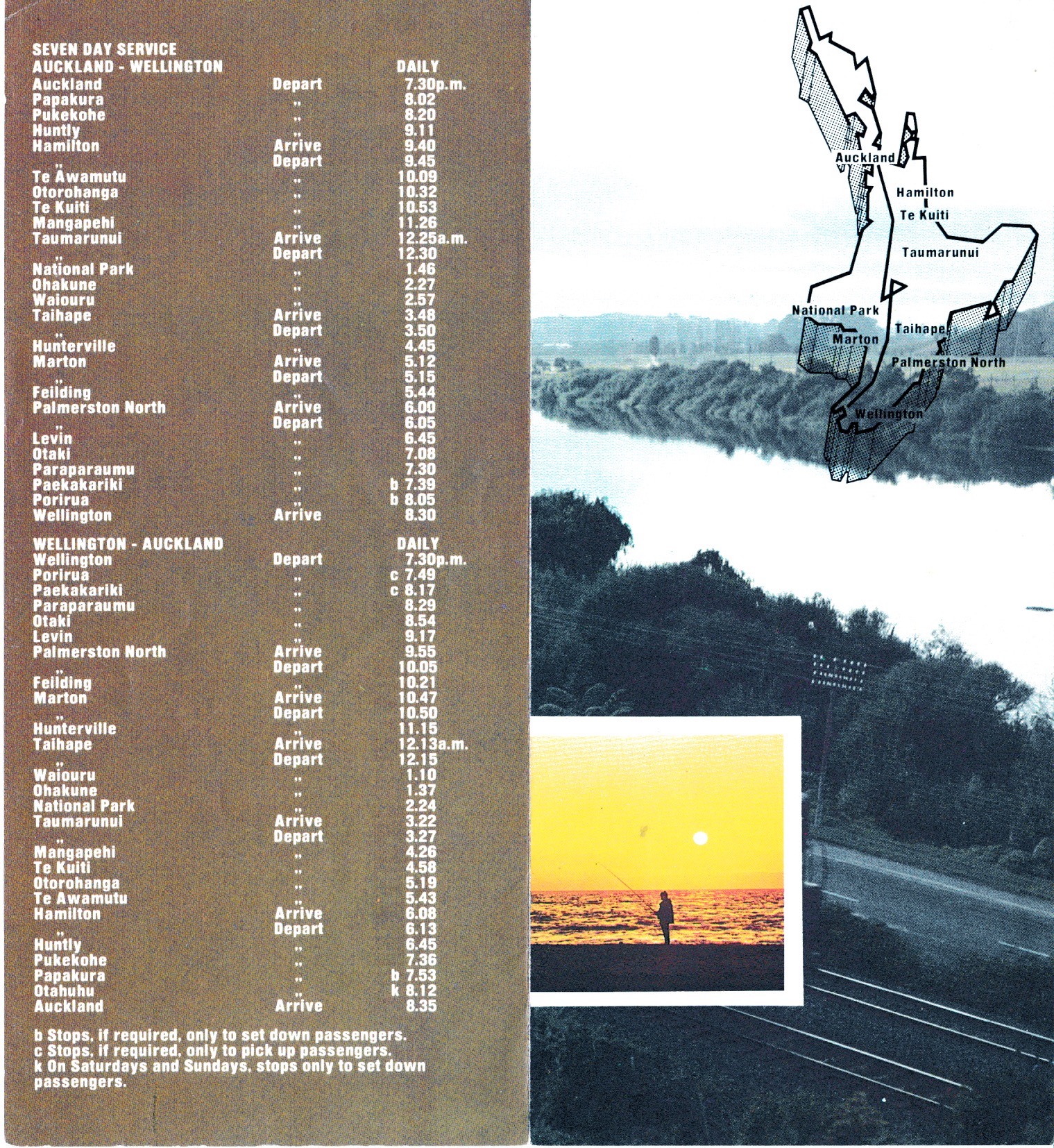
  • The timetable indicated a 13hour (and five minutes northbound) journey time, with many stops at smaller locations like Mangapehi and Paekakariki.
By 1990, however, a lot had changed, as subsidies for long-distance passenger trains had ended, and along with that so had the buffet car and the sleeping cars. It was now "catch a bargain" as it was targeted towards budget travel. It included a summary of the history and engineering feats of the North Island Main Trunk Railway, even though the travel times meant no passengers would ever get to see most of what was described (and the recent electrification was not mentioned at all). 

The timetable was tighter, with 11.5 hours northbound and 11hrs 15minutes southbound meaning later departures (just eat dinner before you board the train!), and with fewer stops.

There was a buffet, but it was a takeaway shop with refreshments available "throughout the night". No great description of seating, because the 2-1 old first class configuration was replaced with a reclining 2-2 configuration like second class intercity services in other countries.  It was noted that main carriage lights are switched off at 10pm and that noise and movement should be minimised after that (no poetic belief in people becoming subdued), with notice that radios and tape recorders (no CDs assumed yet, let alone mobile phones) should be used with earphones (and a reminder nobody could consume alcohol either).

Finally, a notable feature was the seating in the buffet car (which had a servery at one end, but was mostly seats), included a video. This played in the evenings with speakers, and whilst was a trend at the time, was also hardly conducive to restful travel (but I did experience it, twice, when travelling on the Northerner in 1990). 

Although the new Northerner was without sleeping cars or more luxurious seats, it did have three advantages over the old service, it was faster, it had more reliable heating and it was, at the time, commercially viable.