Search This Blog

Showing posts with label Interislander. Show all posts

Wednesday, 25 September 2024

New Zealand Railways Timetables of Principal Service for Tourists and Holidaymakers: 6 November 1983 - 30 April 1984


Continuing a series of timetables is the summer 1983, autumn 1984 edition of the Railways Corporation timetable. This time I have included the NZR Road Services part of the timetable and will focus on the differences from the winter 1983 timetable (again apologies for my childhood doodling on it). Perhaps the only real difference on the front page is the new logo, the stylised NZR logo on an angle is meant to represent speed and movement more than the static logo.  The static logo had its origins in the 1970s under the Railways Department so it was appropriate with the corporatisation on 1 April 1982 for there to be a more commercially oriented look to the Railways Corporation.

The inset and the first page below are virtually identical to the previous timetable, but with the new Road Services logo advertising the overnight coach services.  My intention in publishing the full timetable is to show the sheer extent of NZR Road Services operations, which easily outstrip today's Intercity route and frequency structure, reflecting a time when coach services were much more integral to providing access to many smaller communities throughout the country. This was a time with lower per capita car ownership than was seen 10-15 years later when removal of tariffs on imported cars and easing of restrictions on used car imports saw the cost of buying a car drop significantly. The consequent reduction in car prices saw car ownership increase and the main effect of this was to see a dropping patronage for these services to uneconomic levels.


Unlike the previous edition, the Road Services general information does not come ahead of rail services, which much more conveniently are listed first with once again the Northerner and the Wellington-Masterton-Woodville-Palmerston North train, and Wellington-Masterton services listed. The Northerner timetable is virtually identical, except for some slight changes at the end of each direction's schedule, presumably reflecting changes in the suburban rail timetables in Auckland and Wellington in the morning peak. What IS odd is describing the next service as between Wellington and Palmerston North, when it was clearly not a service intended for such a trip (although there were no services around that time northbound, the Northerner wasn't that much different southbound).  Otherwise that timetable is essentially unchanged, note the large number of on-request stops in the Wairarapa, including Tararua District.


Unlike the previous timetable, the Cook Strait Ferry service (not yet branded the Interislander) was kept from this page, and this time the Silver Fern Railcar actually had the refreshment logo included (yes I drew it on the last one). The Wellington-Gisborne express timetable has not changed, note that only on Sundays would the service stop on request at Shannon, Waikanae and Paekakariki (remember at this time the Wellington electric suburban rail system terminated at Paraparaumu, but had only just been extended from Paekakariki a couple of years before). Other than those stops, only Ormondville was on demand south of Napier, but most stops between Napier and Gisborne were on request only.

The Silver Fern timetable is largely unchanged except for a delay at the end of the Wednesday "Blue Fern" locomotive hauled carriage train service southbound.


Sensibly, the Cook Strait Rail Ferries are on this page with the connecting Christchurch to Picton express timetable. The ferry timetable over this period is varied in part because of the busy Christmas/New Year holidays period, as at the time the DEV Arahura had been introduced into service in December 1983, replacing the GMV Aramoana (the original Cook Strait Rail Ferry), but with that larger ferry and the fleet of the Aranui, Arahanga and Aratika, the four ferry service enabled quite an extensive timetable, with six return sailings on some days, reduced to four from early February 1984. 

The Southerner timetable was notable for having a trial stop at Palmerston over the period of this timetable, as there was effort to attract back patronage from coach services. The Christchurch-Picton express timetable is unchanged, but note the number of on-request stops in Christchurch.  The very locally oriented Christchurch-Greymouth express (which I caught at the time with my Dad once in each direction) had dropped the 0600 departure from Greymouth except on Saturdays, so there was now a daily service each morning (two separate trains) in each direction Monday to Saturday (Saturday it left Greymouth at 0600 enabling an earlier arrival in Christchurch), but with evening only services on Sundays, and Fridays offering the only day return service possible, as there were Friday daytime and evening services. This gave travellers (like my Dad and I) 3.5 hours to explore Greymouth before returning on the evening train (and stopping for a second, third or fourth pie(!) at Otira and Springfield on the way back).


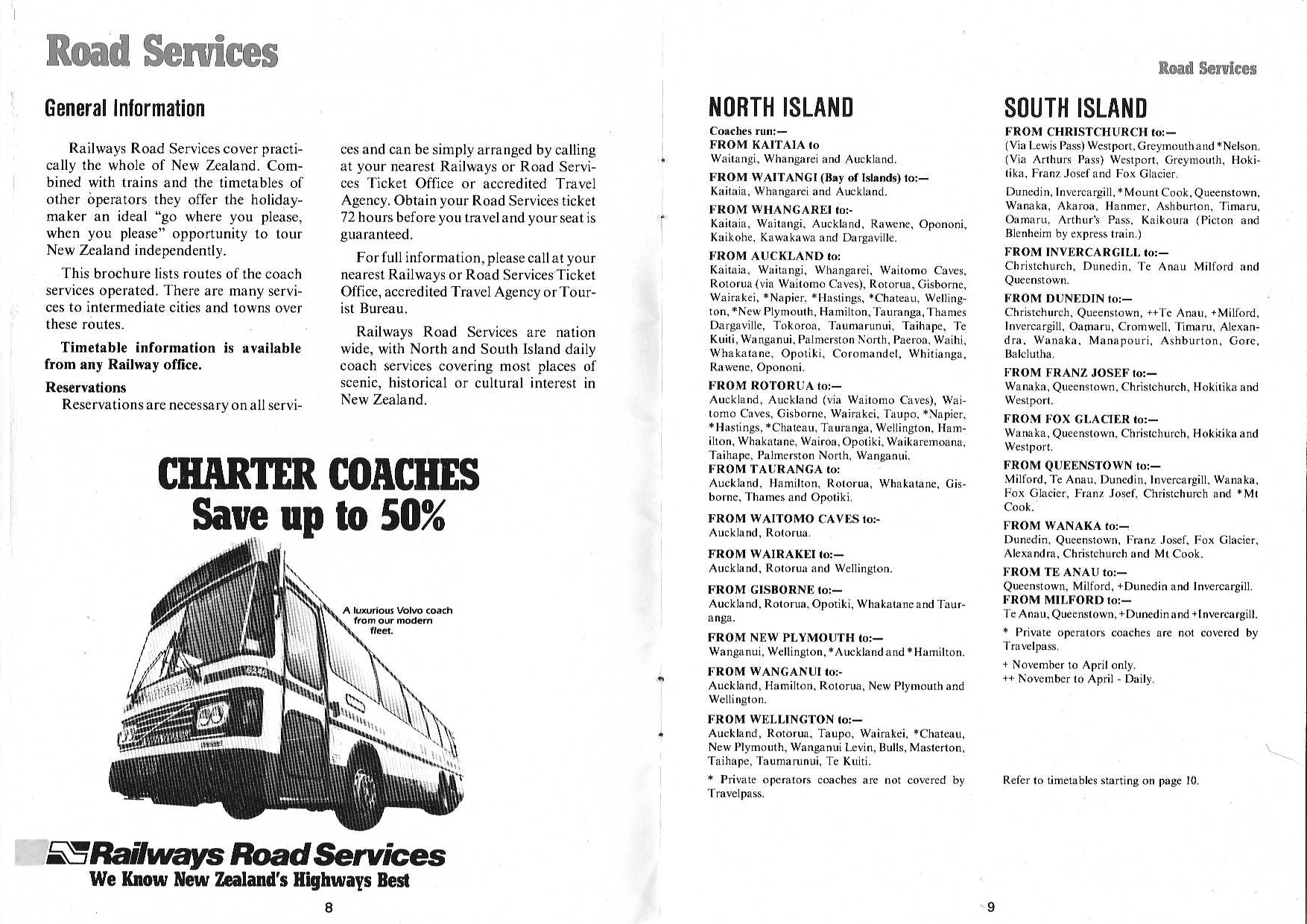
In the previous timetable, this summary of NZR Road Services routes was on the second and third page, again this time with the new logo. Note that some routes are marked as not available by Travelpass, because they were provided by private operators (variably Newmans, Mt Cook Landline and H&H Coaches, all of which are long merged and gone).

The first detailed timetable for Road Services focuses on Northland, with two Auckland-Kaitaia services, one via SH1 and the other via SH10. Note two departures at 0115 (AM) for Kaitaia from Auckland, with the SH10 service clearly intended not for through travellers. Likewise a 0115 service for Dargaville. Was this always three coaches or sometimes two (or one) connecting elsewhere? The timetable seems to indicate they were separate services.


It's fairly clear the Whangarei-Auckland services include the ones going further afield, but this page is focused on two routes between Auckland and Wellington. These services obviously competed with the Silver Fern and the Northerner for some traffic at least. It indicates six daily services between Wellington and Auckland on the two routes, with the 7:00pm overnight Wellington to Auckland service being non-stop (except for pick ups in Porirua and Levin). This intensity of operation indicates demand for a lot of travel between stops, but also how this was a main means of budget travel at the time. Bear in mind domestic air services were, at the time, a monopoly of Air New Zealand with discounted airfares still relatively high. NZR Road Services was the means for those with the most limited means to travel internally.


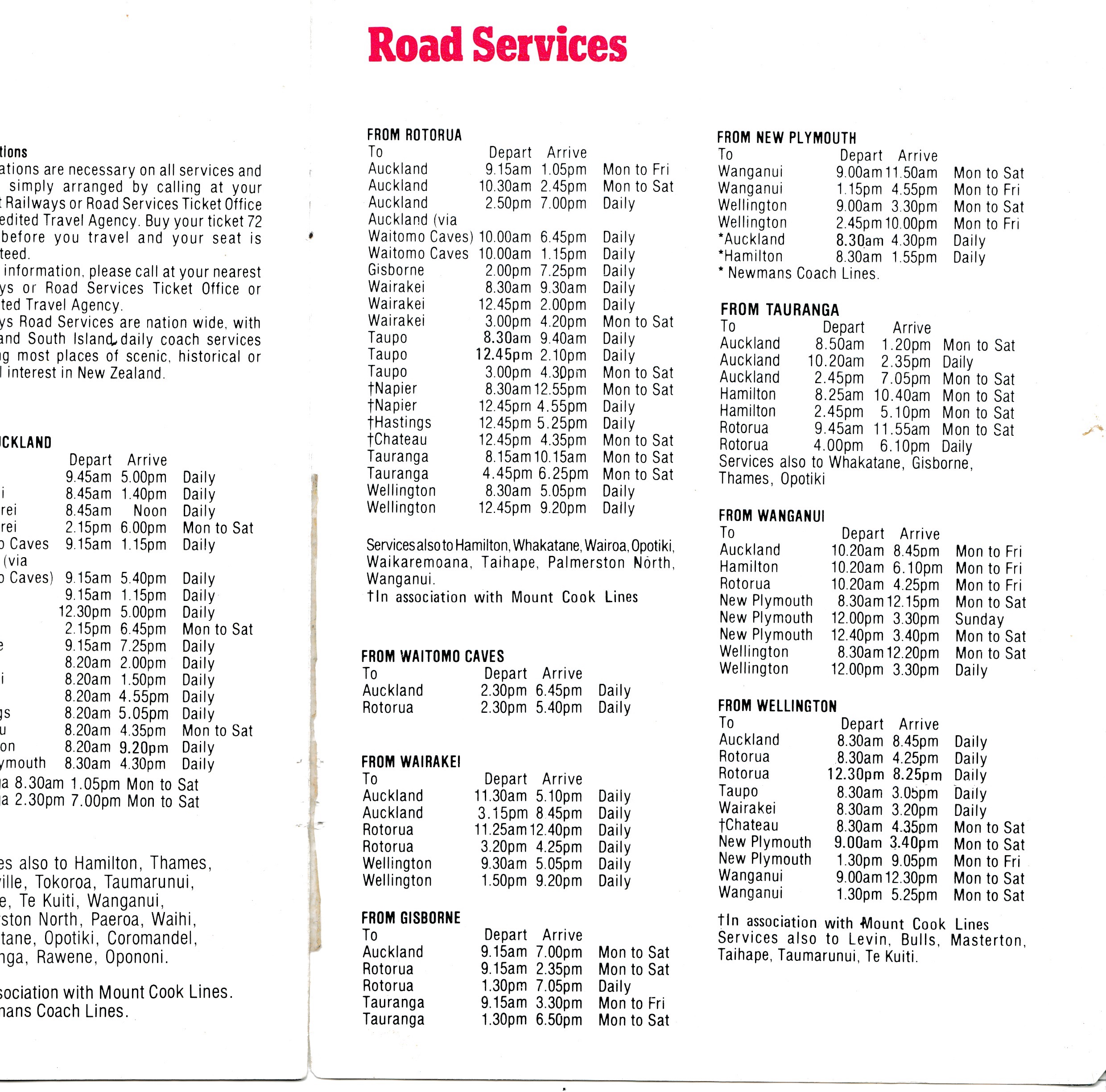
These following pages focus on the Bay of Plenty and Gisborne. The Auckland-Gisborne service ran up to four times a day and was clearly focused on parcel delivery, with services leaving at 12:45am (arriving 12:40pm), leaving 08:25am, 09:15am and 9:15pm. The Gisborne-Opotiki service was all about servicing Tairawhiti communities.  Auckland-Tauranga operated three times a day most days eastbound, but five times westbound! 


Auckland-Whitianga saw the Coromandel Peninsula well served, albeit with most services being other routes stopping at Thames only.  Wellington-Rotorua-Tauranga was a well publicised service as it had no rail competition, but only the overnight service went the whole way.  The Auckland-Napier service may not have been NZR Road Services the whole route, as Mt Cook Landlines operated the route as well.


Wellington-Wanganui-New Plymouth was a core NZR Road Services route since the Blue Streak service was scrapped in 1977. Around five daily services on the route indicates significant patronage, with three leaving in the morning, one in the afternoon, and an evening service, add a second evening service to Wanganui only, a daily Wanganui-New Plymouth service, and a daily Hawera-New Plymouth service, and you have quite the intensity of coach services.  

Few will know that NZR Road Services ran coaches competing with the rail service between Wellington and Masterton, with three services each way on weekdays. Although two of those were at times when trains did not operate. 

Down south the Christchurch to Westport or Greymouth via Lewis Pass service was intended to serve locations not accessible by the rail service.  It included services only to and from Hanmer Springs, as well as a daily service to Westport, and a morning service from Greymouth to Westport then Christchurch. 

The Christchurch-Kaikoura coach was only four days a week at times that did not parallel the rail service, whereas the twice daily Akaroa service harked from the days when Little River Branch had passenger rail which connected to a coach to Akaroa. 


As with Auckland-Wellington, despite having rail service, NZR Road Service ran multiple coach services daily between Christchurch, Dunedin and Invercargill. Two services ran most days the whole route. The daytime service was always designed to parallel the Southerner so passengers could ride the Southerner to a major station (e.g. Timaru or Gore) and catch the coach to smaller centres, with the overnight service replacing the former overnight rail service.  Notable were two additional services between Christchurch and Dunedin most days and another two between Dunedin and Invercargill, designed to meet demand at different times. The Christchurch to the Glaciers coach service went over Arthurs Pass in the days of the zig zag route on SH73.  This nearly 10 hour coach service was quite a run, but did ensure tourists could get to the glaciers cheaply. The Westport to the glaciers services was once daily, but there were three daily services between Greymouth and Hokitika.


This page is primarily Dunedin and Queenstown focused coach services, with twice daily services Dunedin-Queenstown via Roxburgh and Cromwell. A daily service from Dunedin to Wanaka via Cromwell, as well as a regular Dunedin-Ranfurly-Cromwell service which essentially replaced the railcar service on the Otago Central Railway line (still open but only for freight at the time), which had been cancelled in 1978.  Queenstown to the Glaciers plugged the Haast Pass gap (at the time SH6 over Haast Pass was a very unpleasant unsealed route, so was a gruelling 9hr 15min coach trip). A daily Dunedin-Milford and a second service Dunedin-Te Anau only added to the completeness of service in Otago. The Dunedin-Lumsden-Queenstown service sought to serve parts of Southland away from the Southerner service, but also provide the connection that replaced rail from Lumsden to Kingston and on to Queenstown.


The final timetable pages depict the Invercargill-Milford daily service (not a day return by any means) and the Invercargill-Queenstown service which enabled tourists to go south and join the Southerner the following day.  It also included the day return services from Queenstown and Te Anau to and from Milford.  Finally, the map depicting rail, ferry and major coach routes with notable gaps northwest from Hawke's Bay and inland Canterbury/Mt Cook (Mt Cook Landline country) and Nelson, north of New Plymouth (Newmans). 


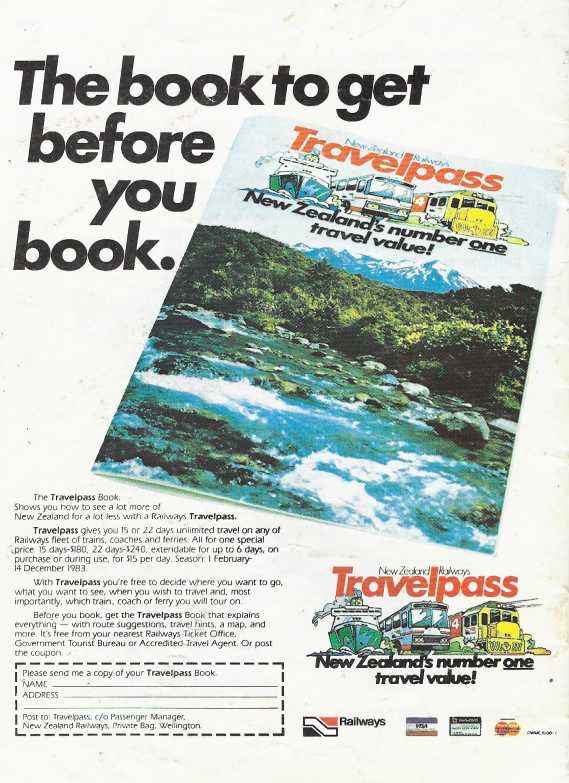
On the back cover is the Travelpass ad similar to the previous timetable, with the same price as before, noting there was a Price and Wage Freeze applicable at the time (the final term of the Muldoon led National Government). 15 days at $180, 22 days at $240, both extendable at $15 per day.


Monday, 16 September 2024

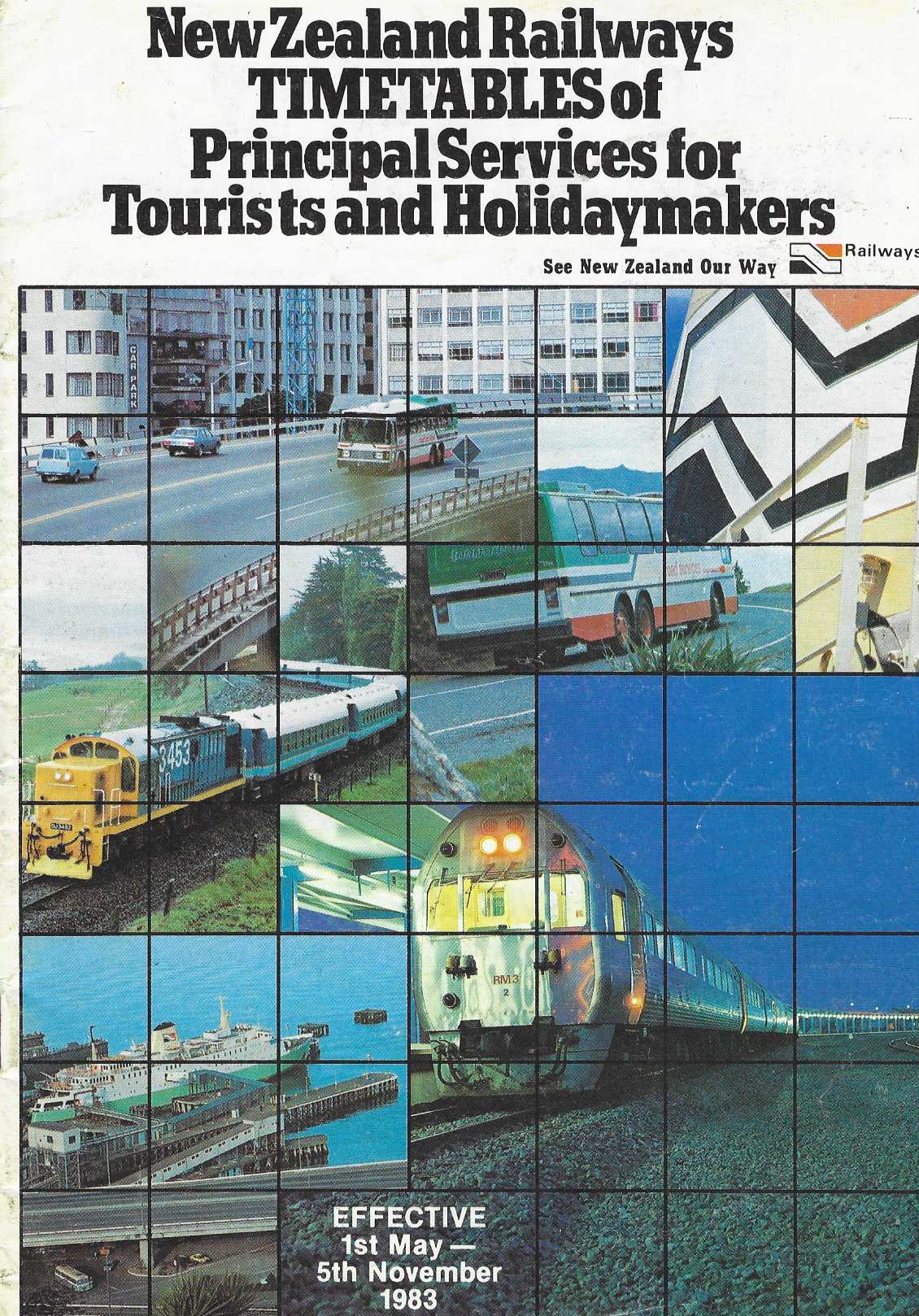
New Zealand Railways Timetables of Principal Service for Tourists and Holidaymakers: 1 May - 5 November 1983


For some years, the Railways Corporation published timetables of its rail, road and ferry long-distance services, and this is one example with a cover used for a couple of years. Here I have scanned the rail and ferry, but NOT the Road Services timetable, which takes up the majority of the timetable. If anyone thinks I should include it, I will, but this blog is focused on rail, not coach services.

The cover page with colour photography has an interesting set of images. At the very top is one of NZR Road Services' new Volvo coaches on the Wellington Urban Motorway approaching the northbound onramp from The Terrace (before a median barrier was installed). To the right is a funnel from the Aratika ferry, nestled just below them is the rear view of a Volvo coach. To the left is a standard image of the day of the Southerner hauled by a DJ class locomotive, and below it the Aratika at Wellington's ferry terminal (the Aratika was, at the time, the "flagship" just before the Arahura commenced service. On the lower right is a double set of Silverfern railcars at Hamilton station.

The scanned pages do include some doodles, as I was a child when I had this, so apologies.

At the time, this timetable included rail services Auckland-Wellington, Wellington-Gisborne, Wellington-Masterton-Palmerston North, Christchurch-Invercargill, Christchurch-Picton and Christchurch-Greymouth. All of these services received direct subsidy from the Ministry of Transport under the category "Social Services Payment".

On the first inset page is an advertisement for NZR Road Services overnight coaches (bear in mind that the Railways Corporation was structured based on operational units, not business units). The main page contains some basic information to understand the timetable noting that children under four accompanied by an adult (!) travel free, and between four and fifteen children travel half price. 


For the timetable of a railway, the first pages focus on Road Services (which by and large, were self-sustaining financially).  The list of routes is printed below, with a focus on locations for tourists. Note that Hamilton, Palmerston North and even Napier routes are not listed. Of course both Napier and Nelson were primarily served by Newmans Coachlines at the time.

The first timetables for trains cover the Northerner and bizarrely the Wellington-Masterton-Palmerston North (and the Wellington-Masterton) services.  The Northerner, at the time with a maximum of six "Day" (seated) cars in a 2-1 configuration with large recliner seats, and a maximum of two sleeper cars (with 8 twin-berth cabins, and bathroom at the end of the car), and a buffet car (with largely 1980s cafeteria style food with some alcoholic beverages), took 13 hours to travel between Auckland and Wellington.

The two weekday Masterton commuter services using old 56ft rolling stock (second class bench seats) were supplemented by a single Friday night return service, a Saturday service scheduled so people from the Wairarapa could spend a day in Wellington, and a Sunday service return in the evenings only.

The Wellington-Palmerston North service was NOT for people travelling between those cities, unless you wanted a long scenic journey, as the travel time was around four hours for a trip that would take only 2hrs 25min on the Northerner, for example (and there were two other trains operating between Palmerston North and Wellington, with the Silverfern and the Wellington-Gisborne express).  It existed to connect the Wairarapa with Palmerston North.  It made sense to be opposite the Northerner, because for SOUTHBOUND travellers, it was a way of travelling from Auckland to Masterton and points north and south, as the Northerner would arrive at 0600 and the train to Wellington via the Wairarapa would depart at 0640 (whether the Palmerston North railway cafeteria was open then is not clear). Northbound it was possible to connect as well, but with a 2hr 20 min gap between arriving at Palmerston North and the Northerner appearing, it was NOT an appealing connection.

Of course the Wellington-Masterton-Palmerston North train at the time was operated by Ac Class "Grassgrubs" converted ex. railcars with no catering.  What is notable compared to the earlier 1982 timetable is the end of the weekend services north of Masterton, including two on Sunday and the additional Friday service, indicating a scaling down of the Wellington-Masterton-Woodville-Palmerston North service.


On this page is the Wellington-Gisborne express, which was operated also by the Ac Class , and with no catering, this train stopped twice for refreshments - at Palmerston North and Napier. A six hour journey from Wellington to Napier was not a fast one, given the drive could be four and a half hours.  Napier to Gisborne was even slower given the topography of the line at four hours 45 minutes northbound, slightly faster southbound. At the time this train was seen as a way of connecting some fairly remote communities with unsealed roads. It was long trip from Wellington to Gisborne by rail then, especially on a fairly uncomfortable train.

The Silver Fern Railcar is surprising left to last for North Island services, odd for the most modern of all of the services (unlike the 38-46 year old 56ft rolling stock, the Silverfern railcars were barely 11 years old, and air conditioned), and for a scenic daytime service between Wellington and Auckland. At the time the Silver Fern offered light refreshments, but with the lunch stop in Taihape (lunch time northbound, mid afternoon southbound) for 25 minutes. 

Wednesdays were NOT the Silver Fern but the "Blue Fern" carriage hauled service operating the ex. Endeavour rolling stock, but with three refreshment stops northbound (Palmerston North, Taihape and the Kuiti) and only two southbound (Palmerston North omitted).  Arguably more comfortable seating (wider and deeper reclining), this service existed because of the need to repair one railcar after the fatal 1981 Waiouru accident.

Also on this page is the four times a day return Cook Strait Rail Ferry service.


The Southerner remained the only rail service in the South Island with on-board catering, operating daily except Sundays (which was odd, given Saturdays were typically a quieter day for travel). The Picton-Christchurch Express continued to operate at this point with refurbished (but basic) 56ft cars, with Kaikoura as the refreshment stop.  The Christchurch-Greymouth Express remained a far cry from the Tranz-Alpine, with a daytime westbound service Monday to Saturday and evening services Friday and Sundays, whereas eastbound oddly had twice daily services listed in mornings (the early train not having a refreshment stop at Otira), and a Friday and Sunday evening service as well.  


Illustrated is a map of rail services, and some highlighted road services, plus a page advertising the Travelpass (which was a pass for rail, bus and ferry travel, but still required reservations to be made for each service).


Friday, 26 May 2023

See the REAL New Zealand by Train (1985)


See the REAL New Zealand by Train

Silverfern and Northerner

Wellington-Gisborne Express and Southerner

Picton-Christchurch Express and Christchurch-Greymouth Express


General Information on travel with NZR

This undated publicity leaflet seems likely to have produced in 1985 reflecting the commercial approach of the NZ Railways Corporation and the then recent upgrade of the Picton-Christchurch rolling stock, but is before the significant restructuring of services that occurred in 1987.  It is notable in depicting the Silverfern as the flagship service for NZR. Notable it depicts drinks being served at ones seat, and the lunch service at Taihape Station Restaurant.  Cigarettes for sale in the smoking cabin, and confectionary for sale, along with free snacks and morning and evening papers (the logistics of getting evening papers partway through the trip may have been interesting).  It only operated Monday to Friday at the time, but as the service with the only truly modern rolling stock, it is unsurprising it came first.

The Northerner depicts the seated cars and a woman laying on a pillow in a sleeper.  However describing it as a hotel on wheels might have been an exaggeration! The sleepers with their own "washing and shaving facilities" with "tea and biscuits" for supper and a morning newspaper. The buffet car is depicted as the social centre open for light refreshments with liquor until 10.15pm. Notable the leaflet mentions there is "plenty of time for a meal before you go", so it wasn't expecting passengers to eat a main meal on board.

NZR focuses on scenery for the Wellington-Gisborne Express primarily because there is zero on-board service. Whereas for the Southerner, it "could be New Zealand's friendliest train" with stewardess service of drinks at the seat, or the buffet car for food, with an "excellent selection of snacks, ales and beverages".  The Picton-Christchurch and Christchurch-Greymouth Expresses are also more about the scenery and the locations along the trip. However, the Picton-Christchurch Express description says there are "new seats and carpeted floors for your travelling comfort".

Finally the leaflet notes Road Services and Searail completing the service roundup, and a page with general information.  Notable is:
  • Checking in with baggage available at either a baggage counter or guard's van 15 minutes before departure
  • Ability to book up to six months before travel (but in person only)
  • Station restaurants or "coffee bars" open at Auckland, Taihape, Palmerston North, Napier, Wellington, Kaikoura, Christchurch, Springfield, Otira and Dunedin. Notable that all of the ones outside the four main centres exist primarily to service the trains that stopped for refreshments, see that some larger destinations like Hamilton and Invercargill have no such facilities. Taihape, Palmerston North, Napier, Kaikoura, Springfield and Otira would all be closed within a few years.

Wednesday, 3 May 2023

Timetable of principal services for Tourists and Holidaymakers - May 1982

In May 1982, the New Zealand Railways Corporation was barely two-months old, so this timetable represented the beginning of a new era of railways in New Zealand operating as a business. This timetable is a guide to all long-distance passenger trains, including Wairarapa services that predominantly were used by commuters. It also includes main NZR Road Services coach routes and the Cook Strait Ferries.  This is notable as the last timetable with the Taumarunui-New Plymouth train service. 

It starts with the Northerner, presumably because it starts in Auckland (the only long distance rail services from Auckland went to Wellington at the time, as had been the case since the mid 1970s), with the logo indicating it has catering, the 13 hour overnight train may have been seen by NZRC as being its "flagship" passenger train. The only train with sleeping cars, the only overnight train, note the reasonably lengthy stops at Palmerston North (northbound especially) and as required pick-up and drop off stops at suburban stations in Wellington and Auckland, noting how it was possible to ride the Northerner from Wellington to Paraparaumu, as the electrification had not been completed to Paraparaumu at this stage (ending at Paekakariki). Odd also that it would only stop in weekends at Otahuhu northbound to drop off only. Some stops like Hunterville and Mangapehi seem quaint today, as the daylight Silverfern railcar didn't even stop at them. This was a train for the small towns as well as the cities.  The trains passed each other between Ohakune and National Park in the night.  

Northerner timetable May 1982

The Silverfern daylight railcar service from Wellington to Auckland is next, with the teacup logo indicating light refreshments at seat, but not a meal service.  It would be some years before on-board meals were served on the train itself. In 1982 a full meal was available at the stop in Taihape, where railway refreshment rooms served a sit-down cooked lunch (which I had once), this would be ordered in advance of arrival.  This worked well time wise northbound, but for the southbound service it did not get into Taihape until nearly 3pm. The half-hour or so stop was a rushed lunch.  Notably, compared to the 13 hour Northerner, the Silverfern was scheduled to run an 11 hour trip.  The odd Wednesday express service listed is NOT the Silverfern, but the "Blue Fern" carriage hauled service using the former Endeavour (Wellington-Napier) rolling stock, but without a buffet car.  This is why the train has refreshment stops in Palmerston North and Te Kuiti (although not Palmerston North southbound).  Arguably the Blue Fern carriages had more comfortable seating (2-1 recliner layout like the old Southerner), but were not air-conditioned.  As locomotive-hauled trains, the Blue Fern took nearly an hour longer than the swift Silverfern railcars.   Notably NZRC didn't approve of passengers buying seats on this service from Wellington to anywhere short of Palmerston North, as it preferred those passengers to travel on the Wellington-Gisborne express which operated around the same time. Of course this service remains as the Northern Explorer, with full on-board catering, but fewer stops.

The other train on this page is one that was dropped 21 January 1983, is the New Plymouth-Taumarunui train, which largely served as a public transport service to the small communities between Stratford and Taumarunui.  This was almost always a two-car train, using 50ft or 56ft carriages from the 1930s (two, one for smoking, one non-smoking), and at the time carried very small loads (often 10 or so passengers per trip).  It had a little utility for long day trips from New Plymouth to Stratford, but by and large was for the likes of Ohura and Whangamomona, because the road network to these communities was unsealed and prone to being closed due to slips and bad weather.  It was possible to go New Plymouth to Auckland on this service, connecting with the Silverfern, albeit with a over 2.5 hour layover in Taumarunui northbound and 3 hours southbound, both of which made it much quicker to go by road coach, let alone drive!  

The pity was how scenic the Stratford-Okahukura part of the trip was, but little effort was made to market it to tourists domestic or offshore, but it remained largely providing Taranaki's last remaining passenger rail service.  It had no catering and no refreshment stops, but the pity of ending this service was that ultimately it saw New Plymouth's magnificent railway station demolished.

Silverfern and New Plymouth-Taumarunui train timetables May 1982

Unlike Taranaki, Hawkes Bay had retained reasonably well patronised passenger rail services, but the August 1981 Silverfern accident which left one railcar out of service for several years saw the relatively comfortable Endeavour train between Wellington and Napier relocated to operate the Blue Fern service as a stop gap.  In the meantime, that service was quickly combined with the Napier-Gisborne train to operate the Wellington-Gisborne express, a long all-day service connecting Wellington-Palmerston North-Hawke's Bay and Gisborne.  The service at this time was operated by very basically refurbished 56ft carriages, all with bench (the old second class) seating, and no catering.  This was similar to the carriages operating New Plymouth-Taumarunui and Wellington-Masterton, and indeed suburban services in Auckland.  The comfort levels on this train may best be described as akin to riding a local bus, as hard vinyl benches were hardly a great attraction on such a long trip.  Adding two 20 minute refreshment stops at Palmerston North and Napier (whereby the traditional rush to the station cafeteria for a pie, white bread sandwich, instant coffee or soft drink would be the order of the day), and it is hardly surprising that patronage took a dive, as  about the main advantage of the train over coach services is having on-board toilets, offset by inferior seating and travel times.  Fortunately a few months later, reallocation of rolling stock saw the Wellington-Gisborne express operated by AC Class former Fiat railcars ("grass grubs") which had individual reclining seats, carpets (!) and so were more comfortable than the suburban interior 56ft cars.  They themselves would operate the route until metal fatigue ultimately saw them replaced by refurbished 56ft cars with better seating, but still it was a service that spent years with a level of comfort ill suited to compete with other modes.

Wellington-Gisborne express timetable May 1982

Notable in this timetable is the Wellington-Masterton-Woodville-Palmerston North rail service which was cancelled 1988. This service mainly enabled a mid-morning departure from Masterton and return from Wellington back, but existed primarily to service northern Wairarapa communities with poor road access.  The service stopped in Masterton for refreshments, as there was a railway cafeteria there.  Of course it wasn't a useful service from Wellington to Palmerston North as it took nearly four hours compared to two hours and ten minutes on the Wellington-Gisborne Express or two hours on the Silverfern.  It's timetable was not useful for anyone connecting to or from Hawke's Bay/Gisborne (except southbound on Sundays), but it WAS a good connection from the Northerner at Palmerston North coming from Auckland (although in the other direction it meant a 3.5 hour wait, so northbound it was hardly attractive). Except Fridays and Sunday when there was a service to connect to the Northerner northbound! The comfort levels were paradoxically better than the Wellington-Gisborne Express at this time, because it was operated with the AC class cars, but this wasn't really enough to attract patronage north of Masterton.  One oddity is how this service was willing to stop at multiple stops in the Hutt rather than simply Petone, Taita and Upper Hutt (this was years before Waterloo would become the hub station in Lower Hutt). 

The timetable also depicts the local commuter Masterton services, which at the time were operated by 56ft carriages.  The service was only two peak services week days, and a later Friday service, plus one Sunday service. 

Wairarapa rail timetable May 1982

Five return Cook Strait ferry sailings were the norm in 1982, with the Aramoana, Aranui, Arahanga and Aratika all sailing at the time (Arahura was about to replace Aramoana and Aranui), and of course the on-board cafeterias justified the ferries being labelled as catered. What is now known as the Coastal Pacific express was the austere Christchurch-Picton express in 1982, and was well scheduled to connect with the 10am sailing from Wellington and 2.20pm from Picton. This train had a refreshment stop at Kaikoura and used the AC Class "grass grubs" at the time.  So it had reversible vinyl reclining seats in a 2-2 configuration.  Curious has to be the comment that stops at Scargill need to be arranged with the District Traffic Manager in Christchurch.  The Southerner timetable is much simpler, with the depiction of it being fully catered (as it did have a buffet car).  It was of course the premium rail service in the South Island, being the only one with on-board catering.

Interislander, Christchurch-Picton express and Southerner timetable May 1982

The rail service now known as the Trans-Alpine was the very locally oriented Christchurch-Greymouth express, which at the time ran twice daily every day except Sunday (which had a single service).  Compared to the single day return service today, it rather inefficiently ran two separate trains each morning departing both termini and arriving at the destination mid-afternoon. Curiously the services did not permit local travel either within Christchurch or even from Greymouth to Dobson.  The morning service from Greymouth left 1hr 40min earlier than the Christchurch departure, except on Saturdays when it was an early start at 0600.  For an only five hour train trip, it is odd that it had two refreshment stops at Springfield and Otira,  note the Saturday early and late services had only one refreshment stop.  As with the Picton-Christchurch express this service was operated by AC class "grassgrubs", but was very much not remotely like the tourist oriented service seen today (or even ten years later).

Christchurch-Greymouth express timetable May 1982

This blog is not primarily about Railways Road Services, but they did form a major part of the intercity passenger network. From Auckland major routes were to Kaitaia, Waitangi via Whangarei, Rotorua, Gisborne and Wellington.  At the time, regulatory limits on competition meant that services to Napier were operated by Mount Cook Coachlines and to New Plymouth by Newmans Coachlines. Note the other destinations listed being part of the extensive network operated largely for social reasons.


Major Road Services North Island timetable May 1982


From Wellington, key Road Services routes were to Auckland, Rotorua and New Plymouth.  Notable is the mention of the long and winding service from Rotorua to Wairoa via Waikaremoana!

Major Road Services North Island timetable May 1982

From Christchurch it is quite notable that there was Road Services routes to Westport and Greymouth, notwithstanding the train service to Greymouth! The other key route is to Dunedin and Invercargill, paralleling the Southerner to serve smaller towns, but also offering later services. Other services connect across the (then) unsealed Haast Pass from the Glaciers to Wanaka and Queenstown, then down to Te Anau, Milford and Invercargill. As in the North Island, Mt Cook Landlines had the monopoly on the Christchurch to Queenstown route, whereas Newmans services Christchurch to Nelson.

Major Road Services South Island timetable May 1982


End of May 1982 timetable