Search This Blog

Showing posts with label East Town. Show all posts

Monday, 20 November 2023

1980s restructuring: Cabinet dispute on EastTown, creative accounting, restructuring success, single person crewing and track maintenance staffing

 This post has a fairly random selection of posts from the 1980s reflecting the period of restructuring...

Dominion 26 June 1986

In 1986 it was clear that Cabinet was about to approve the Railways Corporation closing the East Town Railway Workshops in Wanganui, but this put it at odds with one Cabinet Minister, the then MP for Wanganui, Russell Marshall.  Both Marshall and Railways Minister Richard Prebble had promised before the 1984 election that the workshops would be saved.  However, Prebble also indicated several times after the election that all the workshops could be saved by "rationalising" all the work.  This proved not to be the case, and it was clear by 1986 that five railway workshops could not be retained.  After East Town was closed, Addington would be closed in 1990, and Otahuhu in 1992.  East Town was closed in 1986, but Russell Marshall narrowly retained his electorate in the 1987 election (although he lost over 10% of the vote share). Marshall retired in 1990. 


1 August 1988, 11 May 1989

The 1988 article quoting Victoria University accountancy professor Don Trow questioning Railways Minister Richard Prebble's claim that the reduction in the Railways Corporation's operating loss in 1987 compared to 1986 was "remarkable". Trow noting that the loss reduction was primarily due to a sale in surplus property.  Trow said the Railways Corporation cost taxpayers $269m in that year, consisting of its operating loss, the sale of property and subsidies it received of $69m.

The 1989 reports on then Chief Executive Kevin Hyde presenting at a conference in London about the successes so far of restructuring the Railways Corporation. The presentation noted:
  • Since 1982, 45% of Railways staff had been laid off (from 21,600 to 11,900). 
  • Freight staff productivity increased by 94%
  • Increased train size and moved to single-crewed locomotives
  • Staff reductions had been achieved with little industrial strife
  • Freight rates reduced by 46% due to competition
  • Severance payments to 5,900 staff had cost $175m, but it saved the Corporation the same each year.
The report noted that there would be further staff cuts.


In 1987, the Railways Corporation had three staff on most freight trains, with two in the locomotive cab and one in a guard's van.  The article to the left noted that the Railways Corporation had achieved agreement with the relevant union to reduce the locomotive crew from two to one, starting with the electrified North Island Main Trunk, following with all other freight train services. The main measures needed to support it included some cab modifications and improved radio communications on lines.

In 1986 the Railways Corporation was proposing a significant cut in the Way and Works staffing by around a third. 

Tuesday, 7 November 2023

After the closure of East Town workshops, Wanganui

In 1986, the East Town Railway Workshops in Whanganui were closed, as part of a rationalisation programme originally proposed by Booz Allen Hamilton in 1984. That report said the Railways Corporation only needed three out of the five workshops open at the time, and as the only workshops in a regional centre, East Town was doomed.  Below are articles about some of the people affected by the closure of the workshops. At the time, it was seen as a devastating blow to the town.


Sunday, 14 May 2023

East Town Railway Workshops - 1980


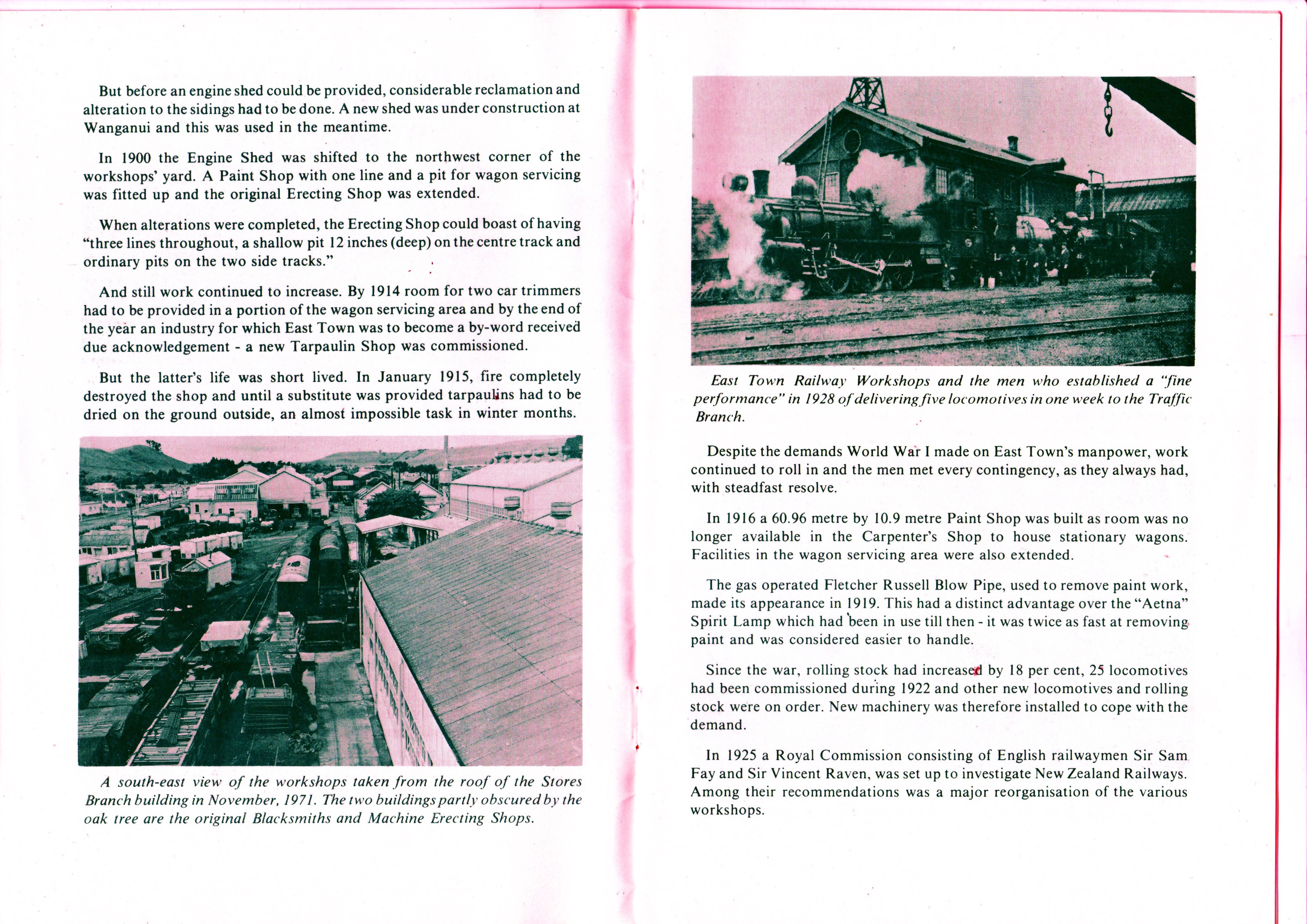
History of East Town Railway Workshops - NZR - 1980

History of East Town Railway Workshops - NZR - 1980 Pg 1-2

History of East Town Railway Workshops - NZR - 1980 Pg 3-4

History of East Town Railway Workshops - NZR - 1980 Pg 5-6

History of East Town Railway Workshops - NZR - 1980 Pg 7-8

History of East Town Railway Workshops - NZR - 1980 Pg 9-10

It's 1980, and the NZ Railways Department has published a leaflet commemorating the 100th anniversary of the workshops opening. At the time, NZR had five major railway workshops, four in the (then) four main centres (Otahuhu, Hutt, Addington and Hillside) and a fifth located in Whanganui (then Wanganui). It was built initially to produce and maintain rolling stock in the central North Island in Taranaki, Manawatu and Hawke's Bay. This leaflet indicates that at the time of publication, East Town was overhauling the DE diesel locomotive fleet (NZR's first diesel locomotive that were not shunters) and re-engining the DSC shunting locomotives. It notes it employed 450 people. The footnote at the end of this leaflet indicates the future "must surely be assured" was not anticipating the effects that deregulation of land transport competition and commercialising the railways would have on its operations.

Ultimately the workshop closed on 17 October 1986 as the NZ Railways Corporation needed to cut costs and consolidate its workshop capacity.  The Booz Allen Hamilton report in 1984 was scathing about the operations of some of the workshops, and recommended two workshops be closed rapidly so that capabilities could be consolidated in the remaining three (the ones proposed for closure were East Town and Addington). The report noted that each workshop produced many of the same items for the system, such as rivet manufacturing, which could be more cheaply sourced externally, and recommended that the each workshop pecialise so there would be economies of scale, and capability building.  Despite campaigning in the 1984 General Election to save the workshop, the Labour Government of the day approved the NZ Railways Corporation closing the workshop in its efforts to get back to profitability.  The news was devastating for the town at the time, as recession and unemployment was already high, and the workshops were a major employer.