Search This Blog

Showing posts with label Annual Report. Show all posts

Friday, 25 October 2024

New Zealand Railways Corporation Annual Report 1985

The 1985 Annual Report marked the third year of the Railways Corporation, but was also notable in marking the first full year of full competition for land haulage of freight.  Also notable was the beginning of the major restructuring of the Railways Corporation business following the Booz Allen report into the future of the railways. November 1984 also saw the end of the price freeze following the election of the Lange Government in July 1984. 

The annual report below has a lot of images of railway staff in various situations, as well as text and data on the numbers for the year. 

In 1985, the Corporation reported a financial loss of just under $20m (that is after receiving Social Services subsidies from the Ministry of Transport at a total value of just under $69.9m for passenger rail services, certain branch lines and some uneconomic road services). Social Services subsidies were down nearly 19% on the previous year.

It did report an operating profit of $2.9m.  It had staff of 18,213 down by  935 on the previous year (Kiwirail has around 4,500 staff today).  While road services and ferry revenue were up, rail revenue was down. 

Rail freight tonnage remained similar to the previous year (increase of 1% in net tonne kilometres although total tonnes hauled was down slightly), but revenue down 8% due to the price pressures of competition. Average distance hauled was 307km. 

The major restructuring evident in this report is consolidating the organisation into three businesses:

  • Freight
  • Passengers
  • Property
This is a marked change from the structure in the Departmental days which was focused not on markets, but on input, such as Way and Works for tracks and associated infrastructure, and the like.  Freight focused obviously on moving goods, but included the rail, road and rail ferry operations.  Passenger included the passenger rail and Railways Road Services passenger operations. Property covered the land and buildings owned by the Corporation, noting the holding of 24,000 hectares of land.

Highlights from the Annual Report included:
  • The launch of Doorrail, offering door-to-door delivery of goods, mode neutral.  So freight would go from customer to end user. 
  • Sale of the two oldest Cook Strait Rail Ferries (Aramoana and Aranui) after their replacement by Arahura, noting only 4% of sailings were interrupted by weather, industrial action and urgent repairs.  Also noted was increased competition on Cook Strait.
  • Continued work on electrification of the North Island Main Trunk line
  • Wagon fleet reduced by 5% (to haul similar amounts of freight) as did the locomotive fleet (predominantly due to scrapping some shunting locomotives and tractors). 
  • Earlier predictions that competition would mean Railways losing "small-lots" of freight and keep mainline bulk and large scale shipments were wrong, with road freight operators focusing on the larger volumes, not the small ones.  This had stretched the Corporation's resources in sales and marketing.
  • $8m worth of land sold, mostly residential to staff in Railway's staff houses. Noting the central Hamilton property development scheme (built on top of the former underground railway station in Hamilton).
  • Passenger business noted the opening up of competition to new road coach services, which saw Road Services launch new routes, with new Auckland-New Plymouth, Auckland Napier- Napier-Bulls and Picton-Christchurch services).  Success of new Volvo coaches for comfort and reliability was noted.  It was also noted that catering services were provided at 19 locations across the country, noting facilities at most locations operated at unusual hours for short intense periods of activity (e.g., serving trains with no on-board catering that stop for refreshments. At the time this included Taihape, Palmerston North, Napier, Kaikoura, Springfield and Otira). 
  • Book value for the assets was around $925m, which was essentially original cost minus depreciation, and bears little relationship to the market value of those assets.
  • Long distance passenger rail patronage dropped by 11% compared to the previous year.
  • Suburban passenger rail patronage rose by 5.6% compared to 1984 (continuing to reflect the improvement in reliability and comfort with the Ganz Mavag rail units in Wellington)
  • Long distance passenger road services patronage dropped by 4.5% compared to the previous year.
  • Suburban passenger road services patronage increased by 1.9% compared to 1984
Part of the Chairman's commentary noted that there are "ambivalent" views of Railways, with some expecting taxpayer funding of services, others thinking it should operate commercially, and the need for the Corporation to work through the various issues in different fields of activity.  

This was an increasingly difficult time as the Railways Corporation would be transformed in the following years, and have the burden of the debt of the North Island Main Trunk electrification (which would not generate sufficient savings to even begin to pay down the debt for the project) and restructuring to make it profitable.


Tuesday, 20 February 2024

New Zealand Railways Corporation Annual Report 1984

In 1984, the New Zealand Railways Corporation (NZRC) completed its second year of operation, and its last profitable year before six hard years of restructuring before it was reformed into a fully-fledged State Owned Enterprise in 1990 (NZ Rail Limited). This highly pictorial annual report contains details of notable parts of the operations of NZRC over the 1984 financial year and some images reflecting some highlights.  At the time, the Chair was Mr Lyndsay Papps and the General Manager was Gordon Purdy.

The 1984 Annual Report saw it report a drop in rail freight tonnage, increase in ferry freight tonnage, but around the same net tonne kms of rail freight hauled in total. As it was the first full year of NZRC faces a fully competitive road freight market (with removal of the 150km limit of road competition with rail), it means NZRC was losing short to medium haul freight traffic, but retaining sufficient long haul freight and operating longer distance trains, to hold steady in total freight hauled. The locomotive and wagon fleet both reduced, reflecting greater efficiencies in operation.

On the passenger side both long distance and suburban rail patronage increased, but NZR Road Services lost patronage.  It is worth noting that at the time, NZRC received direct subsidies from central Government (Social Services Payments) to subsidise long distance and suburban rail services, as well as some freight branch lines and NZR Road Services routes. This arrangement continued until 1987 with restructuring of funding of urban transport that saw regional councils required to share the cost of subsidising urban passenger transport.

The 1984 financial year was also the year that the Booz Allen Hamilton (BAH) report on restructuring NZRC had been received, and so the impacts of that report are not reflected in that year.  It was noted that the North Island Main Trunk (NIMT) electrification project had been approved and was forecast to cost NZ$200m at the time (it would end up cost over 50% more). 

Subsequent years would prove more challenging for NZRC as it started to more clearly identify elements of the freight market that it was commercially viable for it to service.  It would also transition from being input focused (structured around supply of locomotives, rolling stock, right of way and buildings) to selling services to customers. 

Key statistics include:

  • Net profit of $23.9m compared to $24.2m in 1983
  • Reductions in revenue of around $30m compared to 1983.
  • A reduction in staff numbers from 20 865 to 19 148.
  • Wages comprised 55.6% of expenditure.
  • Average rail freight haul distance was 298km, up from 285km in the 1983 financial year (this is a low average by today's standard).
  • 1877 Cook Strait ferry round trips were worked compared with 2153 the previous year. 3.5% of sailings were stopped due to weather, urgent repairs and industrial action.
  • 160km of new rail were installed and 16 rail bridges were reconstructed and strengthened.
  • 471 locomotives in the fleet down from 504 the previous year
Highlighted changes to infrastructure and services include:
  • Introduction of new overnight freight liner express goods services between Auckland-Wellington, Picton-Christchurch and Christchurch-Invercargill.  Train space sold on a "slot" basis to customers including freight forwarders.
  • Introduction of the "Doorrail" door-to-door general goods service in partnership with road operators at 28 key stations.
  • 69 new goods wagons entered service and 191 wagons were modified to handle specialised traffic.
  • Patronage increased on the Silverfern (Wellington-Auckland), Southerner (Christchurch-Invercargill), Wellington-Gisborne and Picton-Christchurch Expresses.  At the time the increasingly worn-out Ac "Grass Grubs" had been replaced with refurbished 56ft cars with new seating, with the Grass Grubs placed on the Wellington-Gisborne route to replace 56ft cars with old-fashioned bench style 2nd class seats.
  • The electrification between Paekakariki and Paraparaumu went live in May 1983
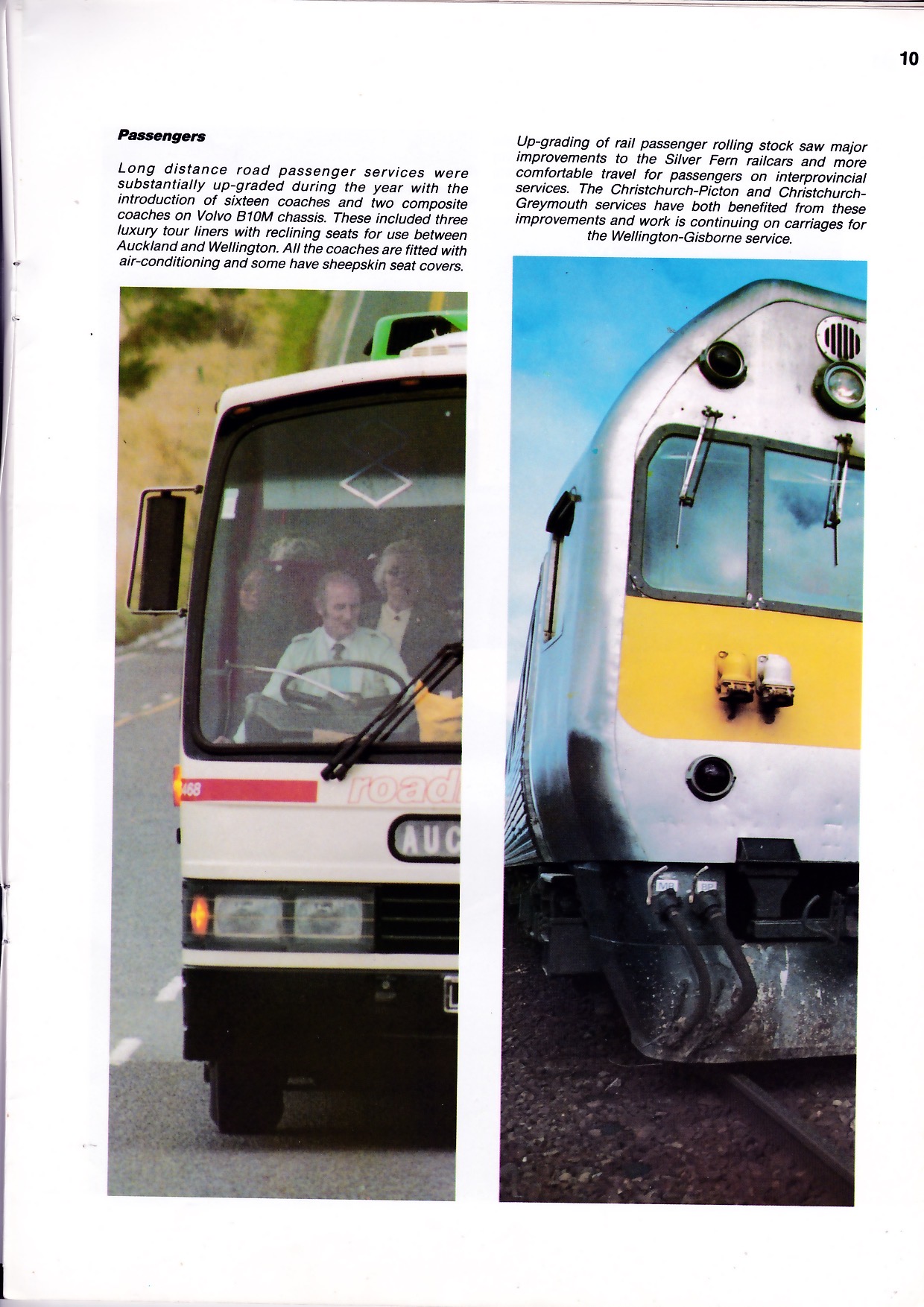
  • 18 new long distance coaches entered service for Road Service and a programme to re-engine 45 coaches with more powerful engines was nearly complete.  Noted new coaches with air conditioning ( a first for NZR Road Services) and some with sheepskin seat covers
  • 25% off peak saver discount for midweek and Saturday long distance rail services was introduced
  • Ferry Aramoana was withdrawn from service in March 1983, but returned to service briefly to clear a backlog of traffic due to weather delays. 
  • Its replacement, the Arahura was delivered in December 1983.  Arahura had capacity for 1000 passengers, 60 four-wheeled wagons or 130 cars on the rail deck, 100 cars on vehicle deck.
  • Contracts awarded for Stage 1 of NIMT electrification
  • New travel centres for Road Services opened in Wanganui and Opotiki
  • New freight offices opened in Tauranga and Morrinsville
  • New administration building and apprentice school opened in Wanganui
  • New signals and apprentice school at Woburn
  • Installation of radio communications in locomotives and trackside was completed for Wellington-Auckland and Christchurch-Picton
  • Completion of the DC/DBR programme
  • Contract awarded for the NIMT electric locomotives to Brush Electrical Machines Ltd of the UK
  • Prototype DSJ locomotive entered service and work commenced on building four more at Addington Workshops
  • Two of out three Silverfern railcars had been refurbished
  • Makohine Tunnel daylighting on the NIMT (pictured)
  • Refurbishment of English Electric EMUs at East Town workshops (these were the 1950s series stock that remained after the Ganz Mavag units replaced the 1930s and 1940s stock).
NZRC Annual report 1984 At a Glance

1984 NZRC Annual Report Chairman's Commentary

1984 NZRC Annual Report Chairman's Commentary including new Volvo B-10M coach


1984 NZRC Annual Report Chief Executive's Review of Operations


1984 NZRC Annual Report Chief Executive's Review of Operations


1984 NZRC Annual Report Chief Executive's Review of Operations

1984 NZRC Annual Report Chief Executive's Review of Operations

1984 NZRC Annual Report highlighting Freightliner trains

1984 NZRC Annual Report highlighting new rail ferry Arahura

1984 NZRC Annual Report highlighting rail infrastructure construction work on the North Island Main Trunk line


1984 NZRC Annual report highlighting new long-distance road coaches and refurbishment to the Silver Fern railcars


1984 NZRC Annual Report highlighting refurbishment of Wellington DM/D class electric multiple units and a train of fibrolite pipes


1984 NZRC Annual Report highlighting work on electrifying the North Island Main Trunk

1984 NZRC Annual Report highlighting new Railways Road Services passenger depots in Wanganui and Opotiki

1984 NZRC Annual Report highlighting main sources of revenue


1984 NZRC Annual Report highlighting main items of expenditure

1984 NZRC Annual Report including print ads for rail freight

1984 NZRC Annual Report back cover

Friday, 24 November 2023

Railnews December 1985

This Christmas edition of RailNews (the in-house NZ Railways Corporation newspaper) was a "bumper issue" covering the ongoing process of restructuring, along with new investments and growth in traffic, as well as ample coverage of staff news. Some major points from this edition:

  • $20m loss blamed on competition with road freight and the price freeze making it difficult for NZRC to respond.  General Manager Gordon Purdy noted that forecasts that deregulation of land transport would see road operators focus on small lots and not long-haul bulk mainline freight was wrong, with road operators concentrating on long haul and bulk loads.
  • New freight service from Whitecraig North Otago to Central Otago using rail and road for vegetables transported to Alexandra markets.
  • Opening and development of Smart Road freight yards near New Plymouth. The yards were built at first to provide more capacity for freight and to service the growing commercial area to the east of New Plymouth. Subsequently, all of NZRC's New Plymouth freight operations would be relocated to Smart Road and the New Plymouth Railway Station and freight yard would be closed.
  • Public consultation on proposed Sockburn-Styx deviation.. NZRC was opposed to the deviation, because it saw no net commercial benefit in the route.  The Railways Department bought land for the route from the 1950s, it was intended to be a bypass of Christchurch for through traffic.  NZRC preferred a direct northbound link at Addington from the south (which was ultimately built).
  • New NZR Road Services passenger and parcels depot is under construction in Cromwell to replace the site to be flooded by the Clyde Dam.
  • Construction of bogies for CA class coal wagons at Hillside Workshops.
  • Decision soon on transport option for West Coast export coal.  The choice was between rail and a slurry pipeline to offshore at Westport. There was concern if the slurry pipeline option was selected it would jeopardise the future of the Midland rail line.   The report noted that 53% of freight shipped by tonnage on the line from the West Coast was coal.  The line in 1985 received a subsidy of $15.6m.  NZRC's proposal was to change the then coal operation . RailNews noted that at the time, 900 LC class wagons were used to transport coal from the West Coast with a five-six day turnover between Ngakawau and Lyttelton, and 10% of wagons are out of operation at any one time for repairs.  They were to be replaced with 56 CB wagons with only a 26-hour turnaround.  This was a significant improvement in productivity. Rail was eventually chosen for long-term export coal contracts and the subsidy was ended.
  • Richard Prebble, Minister of Railways, opened a new Bulls Travel Centre and noting 10 new Volvo coaches would enter service by Christmas (1985).
  • GM's Comment noting that if staff do not provide the service customers expect, business and jobs will be lost.
  • DSJ shunting locomotives assembled at Addington Workshops with help from Japanese interpreters. Four shunters were assembled from Toshiba parts at Addington, with 40% NZ content. 
  • Success in NZRC marketing staff attracting new freight business in Otago, with a particular focus on new traffic in Central Otago.
  • NZRC seeking to recapture wool traffic.
  • Track and signal alterations at Marton to respond to NIMT electrification, including longer trains
  • New publicity campaign at schools along the NIMT to teach safety around electrification