Search This Blog

Showing posts with label Railway Workshops. Show all posts

Tuesday, 7 November 2023

After the closure of East Town workshops, Wanganui

In 1986, the East Town Railway Workshops in Whanganui were closed, as part of a rationalisation programme originally proposed by Booz Allen Hamilton in 1984. That report said the Railways Corporation only needed three out of the five workshops open at the time, and as the only workshops in a regional centre, East Town was doomed.  Below are articles about some of the people affected by the closure of the workshops. At the time, it was seen as a devastating blow to the town.


Thursday, 14 September 2023

RailNews July 1985 - Railways Corporation internal newspaper

RailNews June1985 pg1

RailNews June 1985 pg2

RailNews June 1985 pg3

RailNews June 1985 pg4

RailNews June 1985 pg5


RailNews June 1985 pg6

RailNews June 1985 pg7

RailNews June 1985 pg8

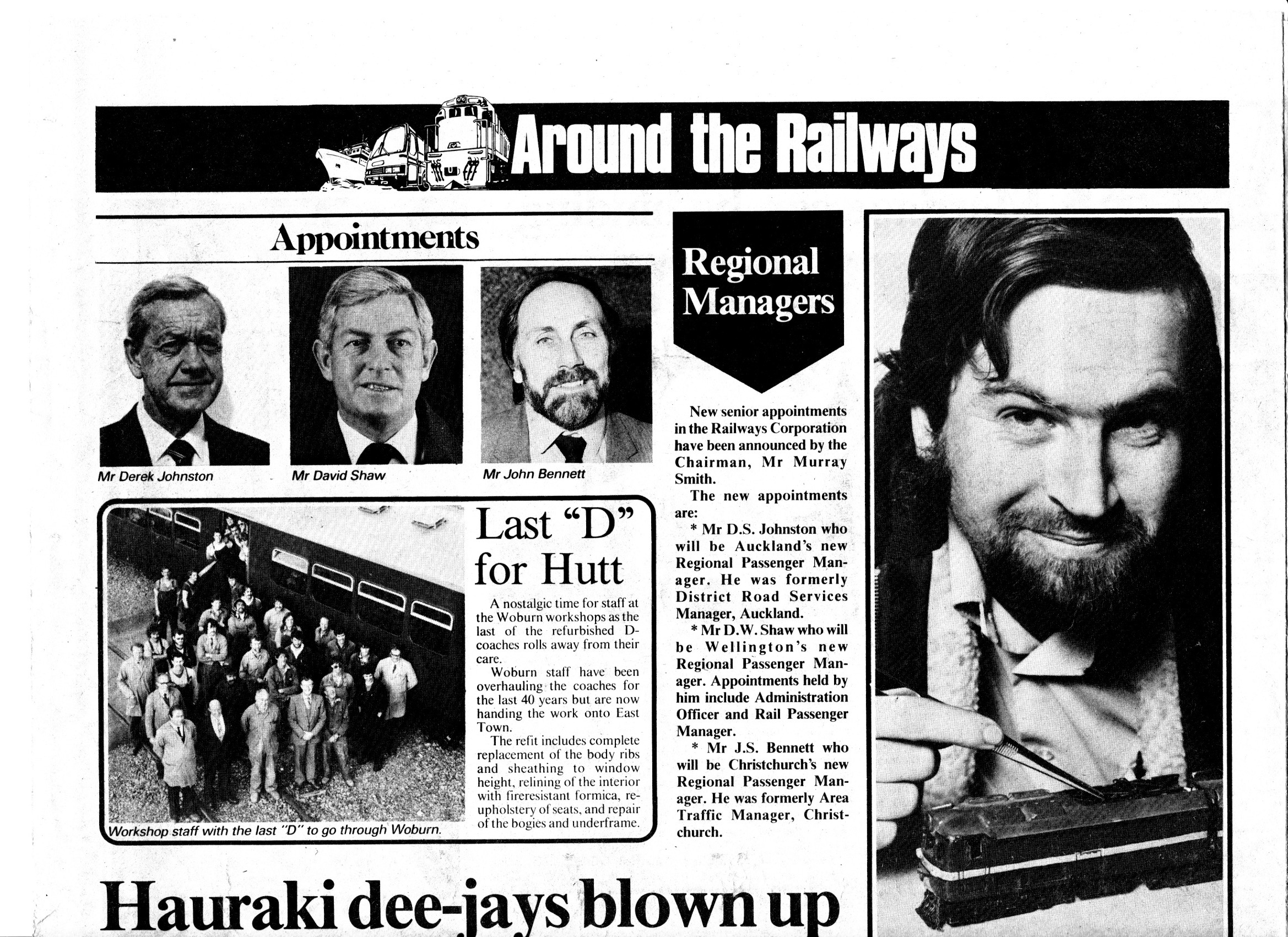
In the 1980s the Railways Corporation had an in-house staff newspaper called RailNews, which include news about business and staff around the railways at the time.  This edition has a lot of stories some of public policy interest, and quite a few of staff interest, and is quite a snapshot of life working for NZRC in the mid 1980s.  Some key points from this edition:
  • The ballot sale of railway houses, enabling staff to buy surplus NZRC houses, with non-negotiable prices, occupation by the purchaser only (not for investment), no right to resell within five years.
  • Opening of the new Railways Road Services travel centre in Otahuhu on the Great South Road. 
  • Beginning of computerised reservations for Searail (Cook Strait ferries)
  • General Manager's comment of a complete re-examination of everything NZRC does.  This included considering organisational changes, alternative manning (code for removing guards vans and second locomotive drivers), new track maintenance policy and a clerical review.  Also under consideration is determining workshop and depot needs. Noting that the policy until the early 1990s will be:
    • Withdrawal of the majority of high-side wagons to be replaced with bogie hopper wagons; and high speed four-wheeled and bogie flat-top wagons capable of carrying multiple container types
    • Stronger coupling hooks and pins on existing drawer to enable larger and fewer trains to reduce operating costs
  • Manufacturing of containers at the Addington workshops at the rate of one per day.  These were NZ designed side-opening containers, with the first 400 built in South Korea.  200 were being built in NZ with components built at East Town workshop, then assembled at Addington.  
  • Women as apprenticed at the Woburn (Hutt) workshop
  • Removal of the Kupe statue from Wellington Railway Station
  • The last D Class (English Electric EMU) to be refurbished at Woburn workshop (at the time)
  • A comic strip depicting a locomotive driver throwing tacks on the road to stop trucks
  • Margharet Matenga from Finance and Accounts included in the NZ netball squad
There are multiple staff members depicted in the newspaper, who may be of interest to their family today.

(Apologies for the scanning which was awkward in places, happy to rescan specific items on request)

Monday, 29 May 2023

History of Addington Railway Workshops


History of Addington Railway Workshops


Like a previous post on East Town, it is unclear quite why NZR published a leaflet on the history of the Addington Railway Workshops in November 1979. It was still a Government Department at this stage, and was heavily engineering focused.  The history indicates that plans to build workshops at Addington were approved in July 1878, and the official site moved to Addington in May 1880, so perhaps it was to celebrate a centenary of the workshops, more or less. 

Notable parts of its history include producing the first saloon passenger cars in New Zealand, and "birdcage" cars enabling outdoor viewing of scenery. It also produced many steam locomotives, from W and Wa class, to A class and the large K class. The almost ubiquitous Ab locomotive was also produced here, providing much of the backbone of many secondary lines across he country.  However, as a steam locomotive producer its time ended in 1926 as it was decided to focus Addington on car and wagon work, with Hillside specialising in locomotives. 

It wasn't just for railway rolling stock though, it also produced bodies for lorries and bridge beams, skips for coal mines and even a radio mast for AM station 3ZB!  It also produced two gold dredges for Kanieri and Arahura on the West Coast.  It was also a munitions factory in WW2. 

After the war it focused on rebuilding old wooden passenger cars as car vans (for guards/luggage), repairing wagons and assembling kit-set wagons from overseas.  It produced DSC diesel shunting locomotives from 1962-1967, then container wagons in the 1970s and Nh four-wheel wagons. It was also notably the workshops where 56ft carriages were refurbished for the Southerner and Northerner "prestige" passenger trains.

The end of the leaflet notes Addington covers 41 acres and employed 900 staff, but also fatefully said it was "sure to continue".  Beyond assembling DSJ shunting locomotives in the early 1980s, it was Addington that followed East Town for closure in 1990.  As with East Town, the Booz Allen Hamilton report in 1984 on the future of the NZ Railways recommended the workshops be consolidated from five to three, and Hillside proved to be the focus for the single South Island workshop (of course subsequently in 1992 Otahuhu closed as well).

The Addington site closure saw the rail network in Christchurch be reorganised to enable a direct link from the Main North Line to the Main South Line southbound, so trains could operate from Picton towards Dunedin without shunting.  It also became the site for the new Christchurch passenger station.

Sunday, 14 May 2023

East Town Railway Workshops - 1980


History of East Town Railway Workshops - NZR - 1980

History of East Town Railway Workshops - NZR - 1980 Pg 1-2

History of East Town Railway Workshops - NZR - 1980 Pg 3-4

History of East Town Railway Workshops - NZR - 1980 Pg 5-6

History of East Town Railway Workshops - NZR - 1980 Pg 7-8

History of East Town Railway Workshops - NZR - 1980 Pg 9-10

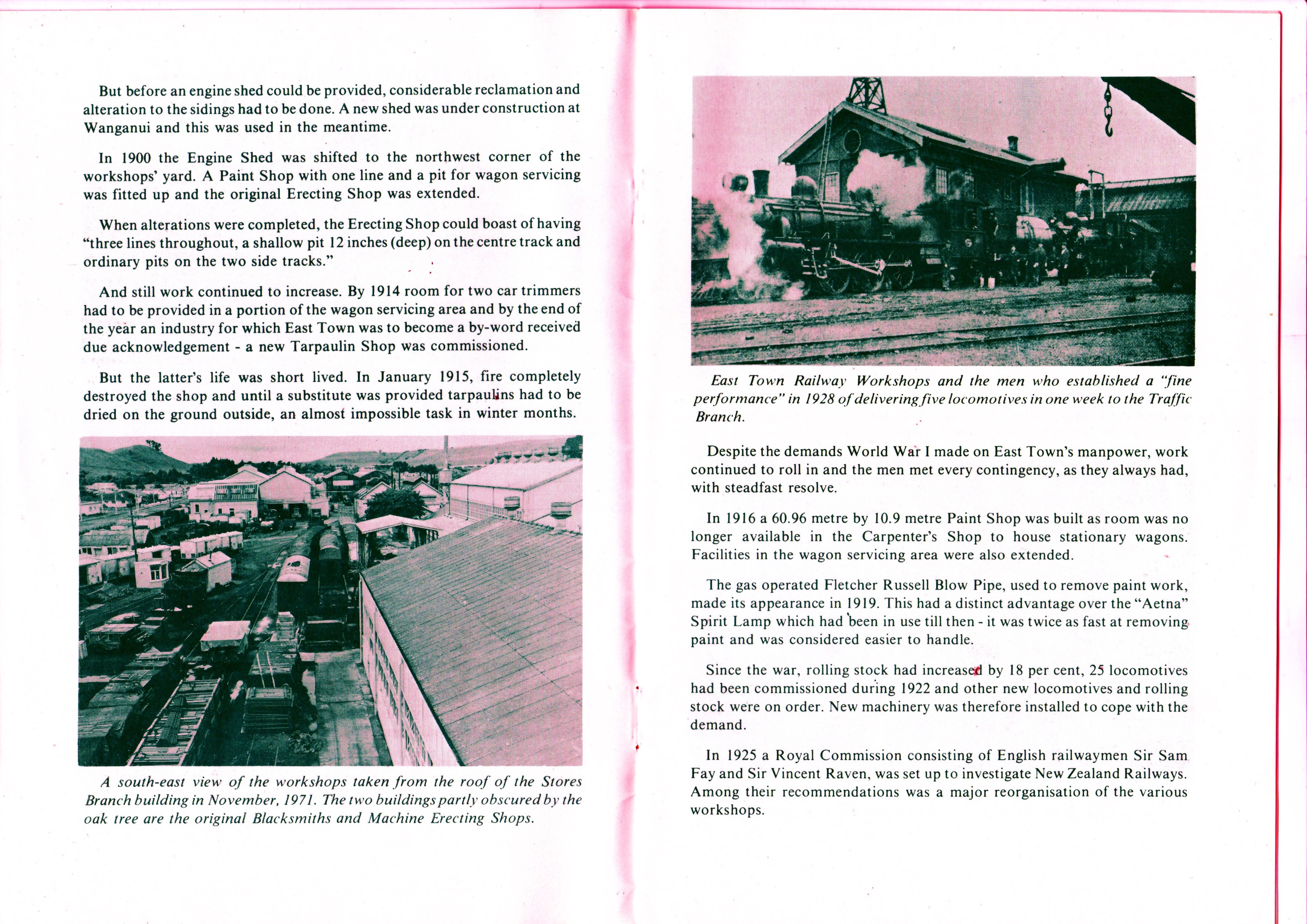
It's 1980, and the NZ Railways Department has published a leaflet commemorating the 100th anniversary of the workshops opening. At the time, NZR had five major railway workshops, four in the (then) four main centres (Otahuhu, Hutt, Addington and Hillside) and a fifth located in Whanganui (then Wanganui). It was built initially to produce and maintain rolling stock in the central North Island in Taranaki, Manawatu and Hawke's Bay. This leaflet indicates that at the time of publication, East Town was overhauling the DE diesel locomotive fleet (NZR's first diesel locomotive that were not shunters) and re-engining the DSC shunting locomotives. It notes it employed 450 people. The footnote at the end of this leaflet indicates the future "must surely be assured" was not anticipating the effects that deregulation of land transport competition and commercialising the railways would have on its operations.

Ultimately the workshop closed on 17 October 1986 as the NZ Railways Corporation needed to cut costs and consolidate its workshop capacity.  The Booz Allen Hamilton report in 1984 was scathing about the operations of some of the workshops, and recommended two workshops be closed rapidly so that capabilities could be consolidated in the remaining three (the ones proposed for closure were East Town and Addington). The report noted that each workshop produced many of the same items for the system, such as rivet manufacturing, which could be more cheaply sourced externally, and recommended that the each workshop pecialise so there would be economies of scale, and capability building.  Despite campaigning in the 1984 General Election to save the workshop, the Labour Government of the day approved the NZ Railways Corporation closing the workshop in its efforts to get back to profitability.  The news was devastating for the town at the time, as recession and unemployment was already high, and the workshops were a major employer.