Search This Blog

Showing posts with label South Island Main Trunk. Show all posts

Thursday, 3 October 2024

1984 NZ Railways travel promotional material


In June 1984 I sent off and received the following bundle of Railways travel promotional material, it included the Travelpass stickers and the "See New Zealand Our Way" stickers using the old Railways Department branding of Rail Ferries and Railways Road Services.

The Travelpass leaflet below advertises the primary multi-modal rail, coach and ferry pass product of the Railways Corporation at the time. It required separate reservations to be taken for all long-distance services.


It cost $160 ($638 in 2024 dollars) for 15 days and $240 ($957 in 2024 dollars) for 22 days of travel. Children 4-14 were half price and under 4yo free. Sleeping berths on the Northerner were subject to a surcharge


The map below depicts the main tourist routes, including interestingly such tortuous routes as Wairoa to Rotorua via the Ureweras.  Notable gaps being between Hawke's Bay and Taupo, Taranaki and Waikato, Nelson and Mount Cook, all serviced by then competitors to the Railways Corporation - namely Newmans Coastlines and Mount Cook Landlines. The images depict the Aranui, a Volvo coach and the Southerner.


Travel suggestions sought to promote the Travelpass to senior citizens, young couples, single young travellers and families, with a range of itinerary suggestions (including visiting Wairoa and going by coach to Rotorua). 


The Cook Strait Rail Ferries leaflet included the newly created brand "Searail" to cover the ferries and depicts the almost brand new ferry - Arahura -  on the cover.


The leaflet depicted outdoor and indoor seating areas, including the bar and even people smoking inside. This also included the connecting Picton-Christchurch express.


This last page on the Rail Ferry leaflet describes the facilities in summary, connections and the ferry timetable at the time.


The package of promotional materials included leaflets for all of the six long-distance passenger services with reservations.  I have already published articles with some of these as follows:

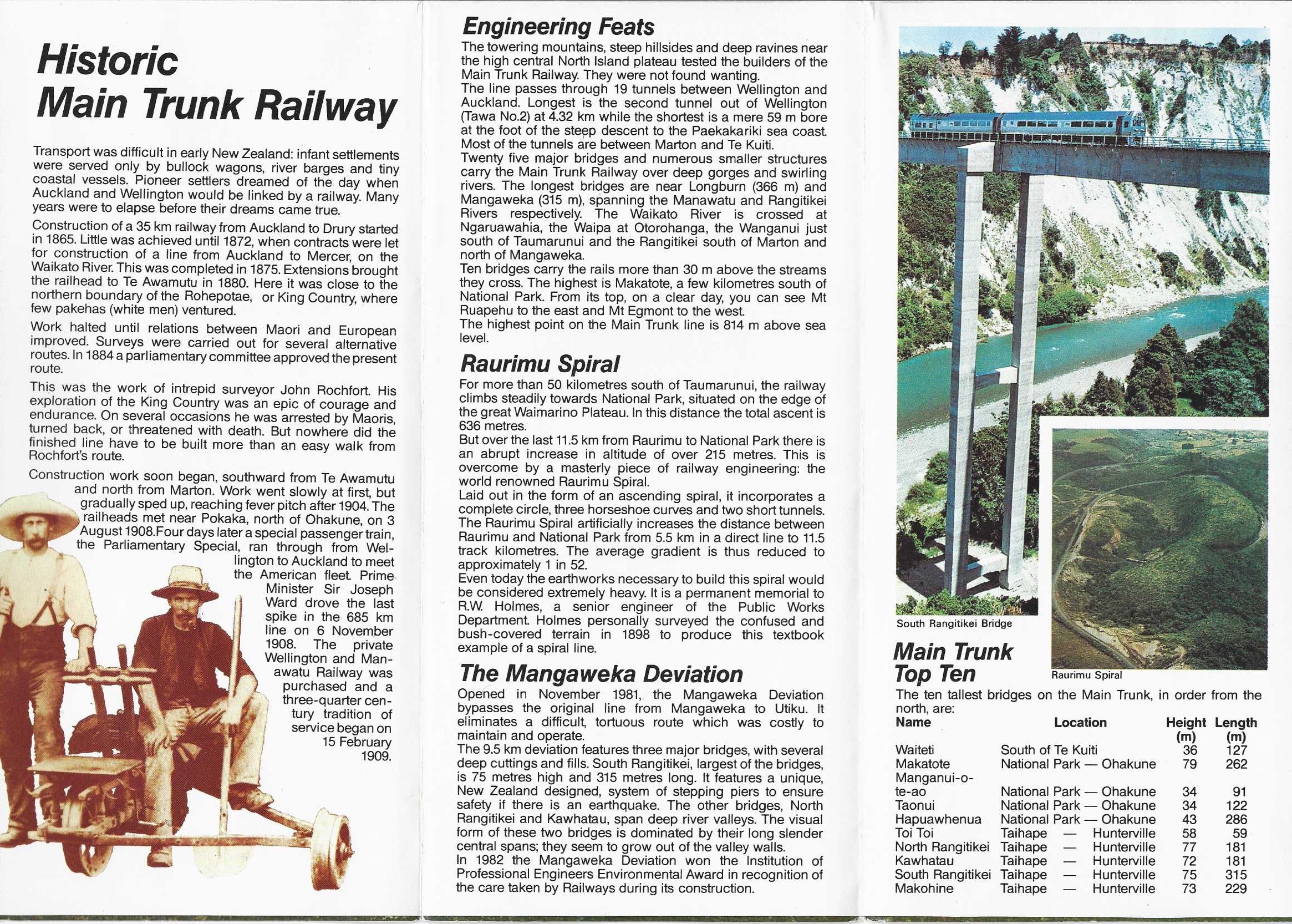
In addition is a leaflet promoting the North Island Main Trunk focusing on the history, the engineering feats, the Mangaweka Deviation (opened two years earlier), promoting the route for scenery.


From the South Island, this leaflet promoted the Picton-Christchurch Express, depicting the recently refurbished 56ft cars. Interestingly it depicts it as a "travel bargain". but also notes that the Railway Station Restaurant at the (now demolished) 1960 station opened at 6:15am serving cooked breakfasts. It also contains the prose of the time describing the route of the train as "a harsh environment". 


The Christchurch-Greymouth express leaflet focuses understandably on the scenery, and the timetable showing the Monday-Saturday daytime services and the Friday and Sunday evening services. It also depicts the recently refurbished (at the time) 56ft cars, although it is unclear what many thought of promoting trains in the 1980s by saying they had carpets, lighting and a heating system!


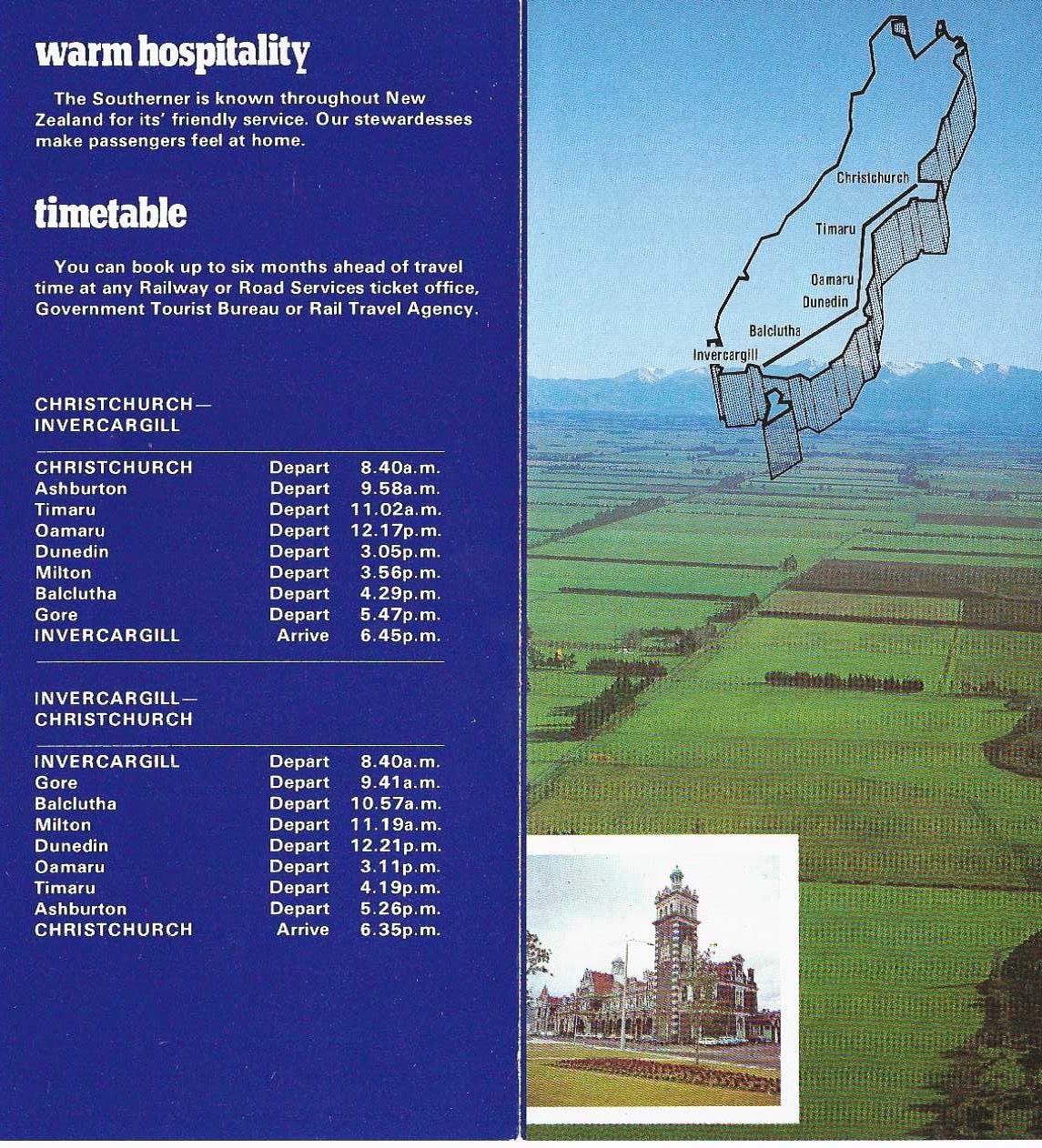
The Southerner promotional leaflet highlighted the buffet car (the only train in the South Island at the time with onboard catering, and along with the leaflet on the South Island Main Trunk (depicting exactly the type of window seen on a Southerner car at the time) , promoting the line as scenic, and noting its history.






Thursday, 10 August 2023

South Island Main Trunk Railway - NZR publicises the route of the Southerner


Route of the "Southerner" (1980 leaflet)

New Zealand's First Main Line

Route map Christchurch-Oamaru

Route map Moeraki-Invercargill

South Island Main Trunk Railway.

New Zealand's First Main Line.

Map Christchurch-Oamaru

Map Dunedin-Invercargill

In 1980, the Railways Department published the first leaflet shown above, about what was then called the South Island Main Trunk line (now more usually called the Main South Line), for passengers riding the Southerner. Notwithstanding that the line was clearly one of the less scenic of the main passenger routes, it was see to be worth promoting to encourage patronage on the Southerner.  The most scenic part of the route was from Oamaru to Dunedin.

The stylised image of the passengers on the Southerner on the front cover reflects a different age, with the history of the line being a focus of the first leaflet. The very first trains took a day and half to make the trip although the leaflet notes the first through train service took 14 hours and 40 minutes (from 1904), with service in 1980 taking 10 hours.  The train itself is noted as having "smart roomy cars" with large windows (which is hardly the case), wall to wall carpet, fluorescent lighting and "oil-fired heaters".  Noting the buffet car and the hostess service to help the "elderly and the infirm".  The longest bridge noted is over the Rakaia River, but beyond that a list of bridges is provided and noting all tunnels are between Oamaru and Mosgiel. 

The map and photos of locations in the first leaflet is more detailed than the second one, with depictions of lines to Picton, Lyttelton, Greymouth, Kurow (closed in 1983), Makareao, Cromwell, Bluff, Mossburn and Wairio, as well as numerous stations along the route that the train did not stop at. The second leaflet is much more simplified with only the main line and the stops for the train highlighted. 

By 1983 the Railways Corporation had decided it was preferable to depict an actual train window (with the winding opening mechanism) through to a scene, presumably of the Southern Alps.  The history is largely unaltered from the earlier leaflet, but a picture of what was the then current Southerner train near Dunedin is included, with DJ class locomotive, four passenger cars, a buffet car, baggage/guards van and Fasttrak parcels Z car.  The earlier leaflet only had some drawings of then Christchurch and Dunedin stations, Moeraki boulders and a "Maori chief" (though there is no direct reference to Maori in the leaflet).

Ultimately the Southerner would prove not to be a train with high levels of overseas tourist patronage by the 1990s and NZ Rail did not promote the line as a scenic trip for fairly obvious reasons that most of the line was fairly unremarkable. However, on balance the earlier leaflet is more informative and visually appealing than the second one, although the latter appears to have focused on possible attractions in towns along the way more than the earlier leaflet.