In May 1982, the New Zealand Railways Corporation was barely two-months old, so this timetable represented the beginning of a new era of railways in New Zealand operating as a business. This timetable is a guide to all long-distance passenger trains, including Wairarapa services that predominantly were used by commuters. It also includes main NZR Road Services coach routes and the Cook Strait Ferries. This is notable as the last timetable with the Taumarunui-New Plymouth train service.
It starts with the Northerner, presumably because it starts in Auckland (the only long distance rail services from Auckland went to Wellington at the time, as had been the case since the mid 1970s), with the logo indicating it has catering, the 13 hour overnight train may have been seen by NZRC as being its "flagship" passenger train. The only train with sleeping cars, the only overnight train, note the reasonably lengthy stops at Palmerston North (northbound especially) and as required pick-up and drop off stops at suburban stations in Wellington and Auckland, noting how it was possible to ride the Northerner from Wellington to Paraparaumu, as the electrification had not been completed to Paraparaumu at this stage (ending at Paekakariki). Odd also that it would only stop in weekends at Otahuhu northbound to drop off only. Some stops like Hunterville and Mangapehi seem quaint today, as the daylight Silverfern railcar didn't even stop at them. This was a train for the small towns as well as the cities. The trains passed each other between Ohakune and National Park in the night.
 |
| Northerner timetable May 1982 |
The Silverfern daylight railcar service from Wellington to Auckland is next, with the teacup logo indicating light refreshments at seat, but not a meal service. It would be some years before on-board meals were served on the train itself. In 1982 a full meal was available at the stop in Taihape, where railway refreshment rooms served a sit-down cooked lunch (which I had once), this would be ordered in advance of arrival. This worked well time wise northbound, but for the southbound service it did not get into Taihape until nearly 3pm. The half-hour or so stop was a rushed lunch. Notably, compared to the 13 hour Northerner, the Silverfern was scheduled to run an 11 hour trip. The odd Wednesday express service listed is NOT the Silverfern, but the "Blue Fern" carriage hauled service using the former Endeavour (Wellington-Napier) rolling stock, but without a buffet car. This is why the train has refreshment stops in Palmerston North and Te Kuiti (although not Palmerston North southbound). Arguably the Blue Fern carriages had more comfortable seating (2-1 recliner layout like the old Southerner), but were not air-conditioned. As locomotive-hauled trains, the Blue Fern took nearly an hour longer than the swift Silverfern railcars. Notably NZRC didn't approve of passengers buying seats on this service from Wellington to anywhere short of Palmerston North, as it preferred those passengers to travel on the Wellington-Gisborne express which operated around the same time. Of course this service remains as the Northern Explorer, with full on-board catering, but fewer stops.
The other train on this page is one that was dropped 21 January 1983, is the New Plymouth-Taumarunui train, which largely served as a public transport service to the small communities between Stratford and Taumarunui. This was almost always a two-car train, using 50ft or 56ft carriages from the 1930s (two, one for smoking, one non-smoking), and at the time carried very small loads (often 10 or so passengers per trip). It had a little utility for long day trips from New Plymouth to Stratford, but by and large was for the likes of Ohura and Whangamomona, because the road network to these communities was unsealed and prone to being closed due to slips and bad weather. It was possible to go New Plymouth to Auckland on this service, connecting with the Silverfern, albeit with a over 2.5 hour layover in Taumarunui northbound and 3 hours southbound, both of which made it much quicker to go by road coach, let alone drive!
The pity was how scenic the Stratford-Okahukura part of the trip was, but little effort was made to market it to tourists domestic or offshore, but it remained largely providing Taranaki's last remaining passenger rail service. It had no catering and no refreshment stops, but the pity of ending this service was that ultimately it saw New Plymouth's magnificent railway station demolished.
 |
| Silverfern and New Plymouth-Taumarunui train timetables May 1982 |
Unlike Taranaki, Hawkes Bay had retained reasonably well patronised passenger rail services, but the August 1981 Silverfern accident which left one railcar out of service for several years saw the relatively comfortable Endeavour train between Wellington and Napier relocated to operate the Blue Fern service as a stop gap. In the meantime, that service was quickly combined with the Napier-Gisborne train to operate the Wellington-Gisborne express, a long all-day service connecting Wellington-Palmerston North-Hawke's Bay and Gisborne. The service at this time was operated by very basically refurbished 56ft carriages, all with bench (the old second class) seating, and no catering. This was similar to the carriages operating New Plymouth-Taumarunui and Wellington-Masterton, and indeed suburban services in Auckland. The comfort levels on this train may best be described as akin to riding a local bus, as hard vinyl benches were hardly a great attraction on such a long trip. Adding two 20 minute refreshment stops at Palmerston North and Napier (whereby the traditional rush to the station cafeteria for a pie, white bread sandwich, instant coffee or soft drink would be the order of the day), and it is hardly surprising that patronage took a dive, as about the main advantage of the train over coach services is having on-board toilets, offset by inferior seating and travel times. Fortunately a few months later, reallocation of rolling stock saw the Wellington-Gisborne express operated by AC Class former Fiat railcars ("grass grubs") which had individual reclining seats, carpets (!) and so were more comfortable than the suburban interior 56ft cars. They themselves would operate the route until metal fatigue ultimately saw them replaced by refurbished 56ft cars with better seating, but still it was a service that spent years with a level of comfort ill suited to compete with other modes.
 |
| Wellington-Gisborne express timetable May 1982 |
Notable in this timetable is the Wellington-Masterton-Woodville-Palmerston North rail service which was cancelled 1988. This service mainly enabled a mid-morning departure from Masterton and return from Wellington back, but existed primarily to service northern Wairarapa communities with poor road access. The service stopped in Masterton for refreshments, as there was a railway cafeteria there. Of course it wasn't a useful service from Wellington to Palmerston North as it took nearly four hours compared to two hours and ten minutes on the Wellington-Gisborne Express or two hours on the Silverfern. It's timetable was not useful for anyone connecting to or from Hawke's Bay/Gisborne (except southbound on Sundays), but it WAS a good connection from the Northerner at Palmerston North coming from Auckland (although in the other direction it meant a 3.5 hour wait, so northbound it was hardly attractive). Except Fridays and Sunday when there was a service to connect to the Northerner northbound! The comfort levels were paradoxically better than the Wellington-Gisborne Express at this time, because it was operated with the AC class cars, but this wasn't really enough to attract patronage north of Masterton. One oddity is how this service was willing to stop at multiple stops in the Hutt rather than simply Petone, Taita and Upper Hutt (this was years before Waterloo would become the hub station in Lower Hutt).
The timetable also depicts the local commuter Masterton services, which at the time were operated by 56ft carriages. The service was only two peak services week days, and a later Friday service, plus one Sunday service.
 |
| Wairarapa rail timetable May 1982 |
Five return Cook Strait ferry sailings were the norm in 1982, with the Aramoana, Aranui, Arahanga and Aratika all sailing at the time (Arahura was about to replace Aramoana and Aranui), and of course the on-board cafeterias justified the ferries being labelled as catered. What is now known as the Coastal Pacific express was the austere Christchurch-Picton express in 1982, and was well scheduled to connect with the 10am sailing from Wellington and 2.20pm from Picton. This train had a refreshment stop at Kaikoura and used the AC Class "grass grubs" at the time. So it had reversible vinyl reclining seats in a 2-2 configuration. Curious has to be the comment that stops at Scargill need to be arranged with the District Traffic Manager in Christchurch. The Southerner timetable is much simpler, with the depiction of it being fully catered (as it did have a buffet car). It was of course the premium rail service in the South Island, being the only one with on-board catering.
 |
| Interislander, Christchurch-Picton express and Southerner timetable May 1982 |
The rail service now known as the Trans-Alpine was the very locally oriented Christchurch-Greymouth express, which at the time ran twice daily every day except Sunday (which had a single service). Compared to the single day return service today, it rather inefficiently ran two separate trains each morning departing both termini and arriving at the destination mid-afternoon. Curiously the services did not permit local travel either within Christchurch or even from Greymouth to Dobson. The morning service from Greymouth left 1hr 40min earlier than the Christchurch departure, except on Saturdays when it was an early start at 0600. For an only five hour train trip, it is odd that it had two refreshment stops at Springfield and Otira, note the Saturday early and late services had only one refreshment stop. As with the Picton-Christchurch express this service was operated by AC class "grassgrubs", but was very much not remotely like the tourist oriented service seen today (or even ten years later).
 |
| Christchurch-Greymouth express timetable May 1982 |
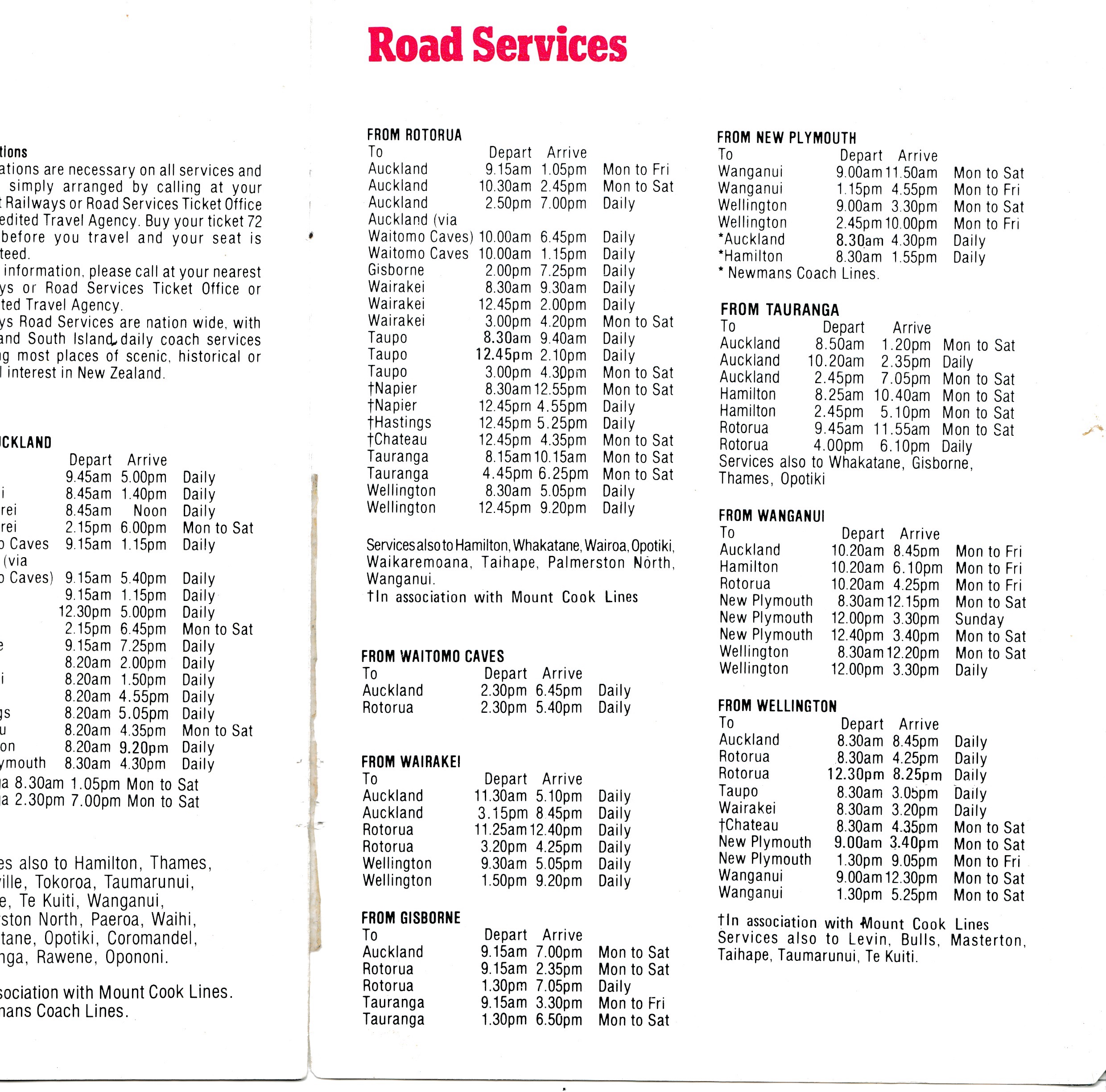
This blog is not primarily about Railways Road Services, but they did form a major part of the intercity passenger network. From Auckland major routes were to Kaitaia, Waitangi via Whangarei, Rotorua, Gisborne and Wellington. At the time, regulatory limits on competition meant that services to Napier were operated by Mount Cook Coachlines and to New Plymouth by Newmans Coachlines. Note the other destinations listed being part of the extensive network operated largely for social reasons.
 |
| Major Road Services North Island timetable May 1982 |
From Wellington, key Road Services routes were to Auckland, Rotorua and New Plymouth. Notable is the mention of the long and winding service from Rotorua to Wairoa via Waikaremoana!
 |
| Major Road Services North Island timetable May 1982 |
From Christchurch it is quite notable that there was Road Services routes to Westport and Greymouth, notwithstanding the train service to Greymouth! The other key route is to Dunedin and Invercargill, paralleling the Southerner to serve smaller towns, but also offering later services. Other services connect across the (then) unsealed Haast Pass from the Glaciers to Wanaka and Queenstown, then down to Te Anau, Milford and Invercargill. As in the North Island, Mt Cook Landlines had the monopoly on the Christchurch to Queenstown route, whereas Newmans services Christchurch to Nelson.
 |
| Major Road Services South Island timetable May 1982 |
 |
| End of May 1982 timetable |