Search This Blog

Monday, 26 February 2024

Transition from NZRC to NZ Rail Ltd and preparing for privatisation

Following the establishment of the NZ Railways Corporation in 1982, and many years of restructuring, the next phase for railways in New Zealand was its reform into a fully-fledged State Owned Enterprise, in the model of other such entities set up after 1985, such as NZ Post, TVNZ and (subsequently privatised) Telecom NZ, Postbank and many others.  NZ Rail Ltd was formed in 1990. 

The first article is reporting the loss for the first half-year of the 1989 financial year, which is put down mainly to the financing costs of the NZRC's $1.1 billion of debt, all of which had been incurred since 1982, and was in part for the capital costs of the North Island Main Trunk electrification and the costs of redundancies and restructuring of the NZRC to remain a viable business after deregulation of land transport. 

The second article following on from the restructuring into NZ Rail Ltd saw the Government take over $1.3b of debt from NZRC to put it on a sounder footing.  The Chair of NZ Rail Ltd  and Managing Director were reported saying it "wanted" to be privatised as it was one of the most efficient freight railways in the world. It expected freight traffic to grow by 20% in the next three years.  It was noted that in the following five years (through to 1996) NZ Rail Ltd would need two replacement Cook Strait ferries.

The third article notes the privatisation of Intercity for $5.1m in 1991, with 60 coaches sold with all of its routes, to a consortium of Guthreys and Ritchie's Transport Holdings. It was noted that Intercity had lost $6m in each of the 1988 and 1989 years, and only $3m in 1990, with the provisional loss in 1991 down to $2m.  NZRC had already sold the Speedlink NZR Road Services freight/parcels business to NZ Post (essentially a transfer between government owned businesses).  The report concluded that the Government was unwilling to inject capital to expand the Intercity business and there was no further scope to restructure. It was also noted that rivals Newmans/Mount Cook (which had recently merged) had chosen not to buy the business (and that there was likely no other buyer than Guthreys/Ritchies).  The privatisation of Intercity was followed by the sale of the suburban bus business - Cityline - to the corporatised Wellington City Transport, which was subsequently privatised by Wellington City Council to Stagecoach.

The fourth article notes in 1991 then State Owned Enterprise Minister, Doug Kidd, reporting that NZ Rail Ltd would likely be sold within the next two years.  He said that it would be a good business and government was not the right owner. He said it was best to sell before it needed new capital for locomotives and ferries. He claimed government could not run railways as a competitive business.  It was noted as the last government transport and communications enterprise, as Air New Zealand, the NZ Line and Telecom had already been privatised. He noted that the rail corridor land would not be sold. It was noted NZ Rail Ltd made a profit of $32m in its first 8 months.

The fifth article from 1992 reports on NZ Rail Ltd's first full year financial results with a profit of $40.2m, which was a 33% improvement (annualised) on the previous year (which was a blend of NZ Rail Ltd and NZRC results). It noted that a scoping study on privatisation was being carried out. Staff were expected to be around 5297.  Sales had been $496m of which 69.5% had come from rail freight, 13.3% the Interislander and 11.4% passenger services (including both long-distance and commuter services, including subsidies for commuter services). It was noted that freight rates had dropped 2.72% and NZ Rail Ltd's fuel costs were only 6% of total costs, compared to 18-20% for competitors. Freight carried was 2.47b net tonne kilometres.  15% of freight was coal, 15-20% log and timber traffic. Passenger services averaged 50-60% full, but the Tranz Alpine was achieving 70-100%. $55m of capex would be funded from profits and debt.

The sixth article from 1992 reports on NZ Rail Ltd threatening to build its own ferry terminal at Lake Grassmere as it negotiates rent with the Port of Marlborough at Picton. It noted it bought land at Lake Grassmere to preserve the option of building its own port.  It noted that NZ Rail Ltd would save an hour on the ferry crossing, and trucks would save an hour of road travel time (and trains 90 minutes for travel towards Christchurch).  Grassmere port was to cost between $50m and $80m at the time, with a new Wellington terminal only $12m-$15m (NZ Rail was also negotiating with Centreport).  

The seventh article from 1991 further noted the earlier articles on NZ Rail Ltd wanting to be privatised, but noting the company was looking to make another 500 redundancies. Managing Director Dr Francis Small said as a private company NZ Rail Ltd could respond faster to major commercial deals.

NZRC General Manager optimistic in 1989, and NZ Rail Chair and CEO want it to be privatised 05/06/91

Sale of Intercity in 1991 - 17 July 1991
NZ Rail Ltd getting ready for privatisation 20/09/1991

NZ Rail first year profit of $40m 27/08/1992

NZ Rail may build its own ferry terminal 27/08/1992


NZ Rail to make 500 further redundancies 06/11/91

Tuesday, 20 February 2024

New Zealand Railways Corporation Annual Report 1984

In 1984, the New Zealand Railways Corporation (NZRC) completed its second year of operation, and its last profitable year before six hard years of restructuring before it was reformed into a fully-fledged State Owned Enterprise in 1990 (NZ Rail Limited). This highly pictorial annual report contains details of notable parts of the operations of NZRC over the 1984 financial year and some images reflecting some highlights.  At the time, the Chair was Mr Lyndsay Papps and the General Manager was Gordon Purdy.

The 1984 Annual Report saw it report a drop in rail freight tonnage, increase in ferry freight tonnage, but around the same net tonne kms of rail freight hauled in total. As it was the first full year of NZRC faces a fully competitive road freight market (with removal of the 150km limit of road competition with rail), it means NZRC was losing short to medium haul freight traffic, but retaining sufficient long haul freight and operating longer distance trains, to hold steady in total freight hauled. The locomotive and wagon fleet both reduced, reflecting greater efficiencies in operation.

On the passenger side both long distance and suburban rail patronage increased, but NZR Road Services lost patronage.  It is worth noting that at the time, NZRC received direct subsidies from central Government (Social Services Payments) to subsidise long distance and suburban rail services, as well as some freight branch lines and NZR Road Services routes. This arrangement continued until 1987 with restructuring of funding of urban transport that saw regional councils required to share the cost of subsidising urban passenger transport.

The 1984 financial year was also the year that the Booz Allen Hamilton (BAH) report on restructuring NZRC had been received, and so the impacts of that report are not reflected in that year.  It was noted that the North Island Main Trunk (NIMT) electrification project had been approved and was forecast to cost NZ$200m at the time (it would end up cost over 50% more). 

Subsequent years would prove more challenging for NZRC as it started to more clearly identify elements of the freight market that it was commercially viable for it to service.  It would also transition from being input focused (structured around supply of locomotives, rolling stock, right of way and buildings) to selling services to customers. 

Key statistics include:

  • Net profit of $23.9m compared to $24.2m in 1983
  • Reductions in revenue of around $30m compared to 1983.
  • A reduction in staff numbers from 20 865 to 19 148.
  • Wages comprised 55.6% of expenditure.
  • Average rail freight haul distance was 298km, up from 285km in the 1983 financial year (this is a low average by today's standard).
  • 1877 Cook Strait ferry round trips were worked compared with 2153 the previous year. 3.5% of sailings were stopped due to weather, urgent repairs and industrial action.
  • 160km of new rail were installed and 16 rail bridges were reconstructed and strengthened.
  • 471 locomotives in the fleet down from 504 the previous year

Highlighted changes to infrastructure and services include:
  • Introduction of new overnight freight liner express goods services between Auckland-Wellington, Picton-Christchurch and Christchurch-Invercargill.  Train space sold on a "slot" basis to customers including freight forwarders.
  • Introduction of the "Doorrail" door-to-door general goods service in partnership with road operators at 28 key stations.
  • 69 new goods wagons entered service and 191 wagons were modified to handle specialised traffic.
  • Patronage increased on the Silverfern (Wellington-Auckland), Southerner (Christchurch-Invercargill), Wellington-Gisborne and Picton-Christchurch Expresses.  At the time the increasingly worn-out Ac "Grass Grubs" had been replaced with refurbished 56ft cars with new seating, with the Grass Grubs placed on the Wellington-Gisborne route to replace 56ft cars with old-fashioned bench style 2nd class seats.
  • The electrification between Paekakariki and Paraparaumu went live in May 1983
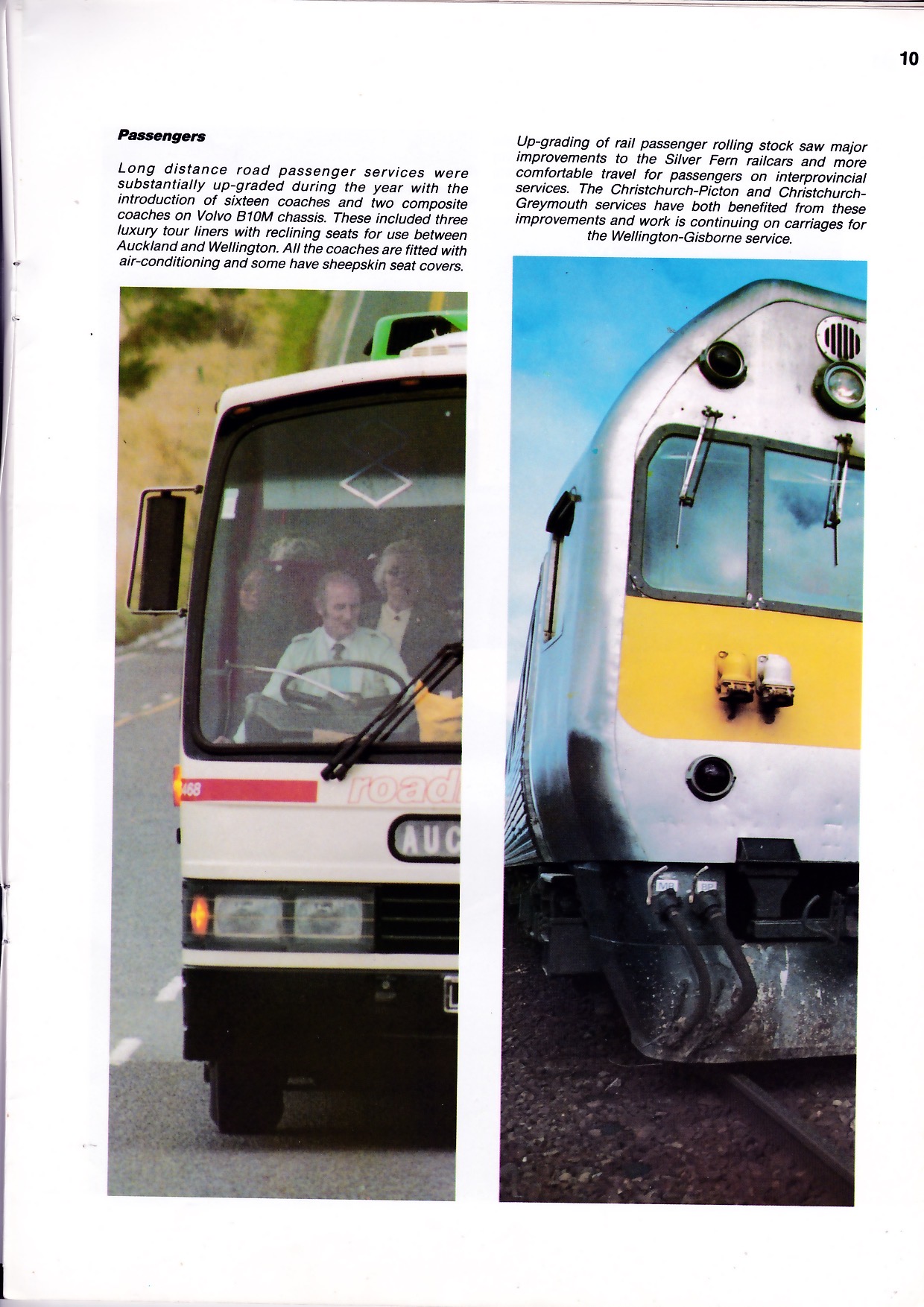
  • 18 new long distance coaches entered service for Road Service and a programme to re-engine 45 coaches with more powerful engines was nearly complete.  Noted new coaches with air conditioning ( a first for NZR Road Services) and some with sheepskin seat covers
  • 25% off peak saver discount for midweek and Saturday long distance rail services was introduced
  • Ferry Aramoana was withdrawn from service in March 1983, but returned to service briefly to clear a backlog of traffic due to weather delays. 
  • Its replacement, the Arahura was delivered in December 1983.  Arahura had capacity for 1000 passengers, 60 four-wheeled wagons or 130 cars on the rail deck, 100 cars on vehicle deck.
  • Contracts awarded for Stage 1 of NIMT electrification
  • New travel centres for Road Services opened in Wanganui and Opotiki
  • New freight offices opened in Tauranga and Morrinsville
  • New administration building and apprentice school opened in Wanganui
  • New signals and apprentice school at Woburn
  • Installation of radio communications in locomotives and trackside was completed for Wellington-Auckland and Christchurch-Picton
  • Completion of the DC/DBR programme
  • Contract awarded for the NIMT electric locomotives to Brush Electrical Machines Ltd of the UK
  • Prototype DSJ locomotive entered service and work commenced on building four more at Addington Workshops
  • Two of out three Silverfern railcars had been refurbished
  • Makohine Tunnel daylighting on the NIMT (pictured)
  • Refurbishment of English Electric EMUs at East Town workshops (these were the 1950s series stock that remained after the Ganz Mavag units replaced the 1930s and 1940s stock).
NZRC Annual report 1984 At a Glance

1984 NZRC Annual Report Chairman's Commentary

1984 NZRC Annual Report Chairman's Commentary including new Volvo B-10M coach


1984 NZRC Annual Report Chief Executive's Review of Operations


1984 NZRC Annual Report Chief Executive's Review of Operations


1984 NZRC Annual Report Chief Executive's Review of Operations

1984 NZRC Annual Report Chief Executive's Review of Operations

1984 NZRC Annual Report highlighting Freightliner trains

1984 NZRC Annual Report highlighting new rail ferry Arahura

1984 NZRC Annual Report highlighting rail infrastructure construction work on the North Island Main Trunk line


1984 NZRC Annual report highlighting new long-distance road coaches and refurbishment to the Silver Fern railcars


1984 NZRC Annual Report highlighting refurbishment of Wellington DM/D class electric multiple units and a train of fibrolite pipes


1984 NZRC Annual Report highlighting work on electrifying the North Island Main Trunk

1984 NZRC Annual Report highlighting new Railways Road Services passenger depots in Wanganui and Opotiki

1984 NZRC Annual Report highlighting main sources of revenue


1984 NZRC Annual Report highlighting main items of expenditure

1984 NZRC Annual Report including print ads for rail freight

1984 NZRC Annual Report back cover

Wednesday, 14 February 2024

Launch of Wellington railway electrification

Today's article is from the Dominion Post believed to be in 2008 as a flashback to the introduction of electric multiple units (EMUs) in the Wellington region in 1938. These were the first EMUs in New Zealand and until 1982 the only one, and until 2014 only the Wellington region had EMUs operating passenger rail services.  Most of the article highlights the reports of the day opening the EMU service to Johnsonville. 

The English Electric EMUs were revolutionary for the development of the Wellington region, essentially opening up both Lower Hutt and Upper Hutt, as well as Tawa, Porirua and ultimately Kapiti Coast as commuter suburbs. The article below highlights the introduction of the then blue and silver EMUs on the Johnsonville line in 1938.  Unfortunately the blue and silver livery w replaced with red in 1949 as an economy measure.

This was only one-year after the North Island Main Trunk (NIMT) had been relocated from the Johnsonville line route to the Tawa Flat Deviation, and so formally converted the Johnsonville line to a modern commuter railway.  The electrification also included introduction of fully automatic signalling.  The Tawa Flat Deviation and NIMT electrification as far as Paekakariki was not completed until 1940, but by 1938 "Ed" Class electric locomotives were regularly hauling passenger and freight trains through the long Tawa Flat tunnels as far as Porirua, although additional EMUs were not supplied until the late 1940s to enable them to be introduced on the Paekakariki section in 1949. 

The article notes that Wellington City Council was relieved that NZR had electrified the Johnsonville line, as it provided infrastructure to support the growth of housing in its northern suburbs, as it saved the Council from expensively extending its tram network north of Thorndon, or bus services (which in the 1930s were almost entirely feeders for tram services, with no major bus routes being operated by WCC). Additional stations on the line would be opened in the subsequent 25 years or so, at Raroa, Box Hill and Crofton Downs, to respond to growth in housing.

There were ultimately three sets of English Electric EMUs introduced in Wellington (the D/DM class) between 1938 and 1954:

  • 1938 set (for the Johnsonville line) known as the "36 stock"
  • 1946 set (for the Paekakariki line) known as the "42 stock" 
  • 1949-1954 set (for the Hutt lines) known as the "46 stock".
The original 1938 set were all phased out by April 1983 with arrival of the Ganz Mavag Hungarian-built (EM/ET class) EMUs in 1981.  


Friday, 26 January 2024

Land transport deregulation comes to pass

From the 1936 until 1983, transport of freight within New Zealand was subject to fairly blunt distance limits restricting competition between rail and road.  Initially, road freight was only allowed to haul goods no further than 30 miles from the nearest railhead, whether it be the end of a line, or a railway station with freight service.  It was designed to save the economy money, primarily by ensuring that capital investment in New Zealand Railways (NZR) was not wasted and undermined by competition from road freight, as it was thought the country it would be wasteful to have to upgrade the highway network to handle long-distance road freight traffic, as well as maintain and develop the rail network. "Unnecessary duplication" was the catchphrase.  It gave NZR a monopoly on all medium to long haul freight, and limited truck operators to feeding the rail network, although there were parts of the country much further than 30 miles away from the rail network, so some trucking companies focused on the gaps. 

Some of the largest centres without rail access were (and are) Kaitaia, Taupo and Queenstown.  The 30-mile limit (50km) was extended to 40 miles in 1961, reflecting improvements in road and truck technology, and the shift of the rail network from steam to diesel traction, indicative of the inefficiencies of rail handling short freight movements. This saw some lines close not long after.  However, by 1961 exemptions based on types of goods were also being introduced.  Early exemptions included household removals and livestock, and the list of exemptions would grow over the subsequent twenty years. 

In 1969 US consultants Wilbur Smith & Associates published a comprehensive review of transport policy in New Zealand and recommended removal of the distance limit, but only if road user charging was introduced concurrently.  In 1978 this partly happened, when the limit was increased to 150km and Road User Charges were introduced for all heavy vehicles (over 3.5 tonnes gross vehicle weight) to recover the costs imposed by higher weight vehicles on the road network.  The shift to the 150km limit saw NZR abandon multiple branch lines almost overnight (see Methven, Waiau, Tuatapere), but it was only a short reprieve.  

After the Railways Department was restructured into a business as the NZ Railways Corporation from 1 April 1982, the then Muldoon Government proceeded to remove remaining distance limits on road freight.  The article below reports both on the merging of Trailways and ASC Flowers trucking companies. 

It also noted the curious way deregulation was implemented. Trucking operators had to buy licences based on capacity to operate further than 150km. This requirement was phased out over three years. 100,000 distance permits had been printed to be displayed in trucks.  Licences were available at Post Offices and MoT offices (when there were many of these).  The final stage was the abolition of quantitative licensing in 1984, replaced with qualitative licensing. Quantitative licensing meant that new trucking operators would have to demonstrate demand for their services due to insufficient capacity provided by existing operators and NZR.  Qualitative licensing simply meant that a trucking operator only needed to prove it met basic legal standards around safety and competence.


Tuesday, 23 January 2024

Restructuring - Coopers & Lybrand report damns main trunk electrification and writing off of NZR debt

This series of articles covers the restructuring of NZRC from 1985 through to 1990, specifically:

  • NZRC announcing a loss for the 1985 financial year but predicting profitability in the 1990s, including a description of a wide range of restructuring measures following the Booz Allen report
  • Coopers & Lybrand report in 1987 focused on the economics of North Island Main Trunk electrification, but also what else NZRC would need to do to become financially viable
  • Agreement with unions to have single person crewing of most freight trains (removing locomotive assistants)
  • 1989 article on review of governance of NZRC (which resulted in all of the non-land assets being transferred into a full-fledged SOE - NZ Rail Ltd) and disposal of non-core assets
  • 1989 article on the possibility that some NZRC business units could be sold
  • 1989 article on the $0.5b loss of NZRC, primarily due to writing off asset values, redundancy costs and interest on debt
  • Government writing off $360m of NZRC debt for the cost of the North Island Main Trunk electrification.
  • Government writing off the remainder of the $1.1b of debt as part of the process to convert NZRC into a state-owned enterprise. This debt was considered to be due to the cost of restructuring including redundancies.

Key points from the articles include:
  • NZRC made a profit of $24m in 1983, but lost $20m in 1985 (this is after "social services subsidies" from government to cover losses for commuter passenger rail and bus services, long distance passenger rail services and marginal branch lines for freight)
  • In 1985 NZRC believed it would be returning dividends to shareholders within five years
  • 130 "repositioning projects" existed in 1985 to restructure the business
  • Deregulation of land transport along with becoming a Corporation had had a traumatic effect on NZRC as it was simply not responsive enough to changes in demand from customers or in responding to competition more generally. "Inefficiency was built into the system". 
  • In 1987 Coopers & Lybrand suggested some lines would need to close, RUC would need to increase and NZRC would need a major capital injection if it were to survive
  • Coopers & Lybrand said the North Island Main Trunk electrification project should not have proceeded and would lose NZRC $100m over 35 years (even if electricity were free, it would still lose $76m over 35 years).  The main reasons being that deregulation of land transport had reduced demand below levels needed to justify the project, and forecasts that oil prices would rise sharply compared to electricity were wrong (oil prices having dropped 50% since the decision to proceed with the project had been made).
  • Coopers & Lybrand also noted that while NZRC had responded to the challenges of reducing costs and becoming more competitive, it needed to do more.  This included having stronger drawgear to enable longer trains and to concentrate on markets where rail can be most competitive, such as haulage of containers.  
  • In 1987, Minister of Railways Richard Prebble asked Cabinet for NZRC to get a $400m capital injection (this was subsequently approved for the write-off of debt incurred for the main trunk electrification
  • North Island Main Trunk electrification was estimated to cost $337m in total
  • NZRC lost $0.148b in the 1987 financial year, primarily due to debt servicing costs
  •  NZRC lost $0.57b in the 1989 financial year, although it was only an operating loss of around $41m for the previous 15 months.
  • Average train size had increased 20% between 1983 and 1989
  • tonne-km of freight moved per staff member had increased 94% between 1983 and 1989
  • Staff numbers had been cut 60% between 1983 and 1989


Thursday, 18 January 2024

Booz Allen Hamilton report recommends major reforms to how NZ Railways Corporation operates

In 1984, the international management consulting firm Booz Allen Hamilton (BAH) released a comprehensive report on the financial, operational, governance and capital position of the New Zealand Railways Corporation. The report was commissioned to identify what NZRC needed to do to respond effectively to the deregulation of land transport (removal of the 150km limit of competition between rail and road).  It compared NZRC to other railways globally and modelled various scenarios as to what it would take to make NZRC financially self-supporting (independent from subsidies for urban public transport operations).  The recommendations were far reaching.  The article below contains some major points from the report including NZRC's response to the report.  At the time NZRC had 19 975 staff (Kiwirail has 4 500 staff today).

The BAH report was a groundbreaking study that informed the transformation of NZRC in the following years, more detail of the report will be published in a later post, but this article reported on the findings in early 1984 (this was in the final months of the Muldoon Government, but the Lange Government allowed NZRC to proceed with the recommendations as it saw fit). 

The key motivation was to survive intense competition particularly from road freight, but also interisland ferry services.  

 Key points were:

- Staff to be cut by over 6000 over five years, of which around 500 a year will be through natural attrition (BAH recommended 8000 be cut)

- Guards vans expected to be removed from trains along with locomotive assistants (the latter cost $20m a year essentially to provide train drivers with a companion), reducing staffing of most freight trains from three to one (three being a legacy of the steam age)

- Train lengths to be increased (noting train lengths in NZ are relatively modest by global standards) with increased drawgear (coupling) capacity, including introduction of automatic couplers (most couplers at the time needed manual hooking - unhooking adding considerable costs to shunting)

- At least one of the five workshops to close (BAH recommended two, ultimately three were closed).  Although employees were hard working in workshops, work methods and machinery used were antiquated and labour intensive

- Ferries to be staffed on a volume-variable basis, whereby staffing was based on need due to demand, rather than the same staff regardless of numbers of passengers, rail and road vehicles per crossing.  Ferries performed well but were generally over-staffed and had poor cost control

- Road Services bus operations needed to be better co-ordinated with rail.  Long distance coaches were substandard in terms of reliability, performance and passenger amenity. Curiously the consultants said personnel were "unusually friendly and helpful" (which may reflect culture)

- Restructuring into business units, away from input based units. Three units were freight, passenger and property. Previous structure had separate divisions for locomotives, rolling stock, track infrastructure, stations, ferries, Road Services and catering.  Freight will be responsible for infrastructure and ferries. Passenger will include Road Services and catering. 

- Consolidation of freight stations (significantly reducing the number of stations which will handle freight into fewer major customer or regional centres)

- Increasing weekend operations (for better utilisation of rolling stock) 

- Modernising the wagon fleet (bogie wagons to replace 4-wheeled wagons)

- Options for long distance passenger trains were presented, with the preferred one being for main trunk trains to be upgraded by refurbishing the mothballed Silverstar to be a single daylight and overnight train (half sleeper/half seated) for Auckland-Wellington to replace Northerner and Silverfern services, with the Silverfern railcars to operate Picton-Christchurch-Dunedin. No comment was made of regional services, but it was expected no service would operate to Invercargill.  Ultimately, the Lange Government did not fund the Silverstar refurbishment, and instead provided a capital injection for NZRC to restructure long distance passenger rail to be financially sustainable.

- New Deputy General Manager to be Bob Henare. 

- NZRC's 1984 financial year to end in a modest profit but under $24m, which for assets worth around $1b was not seen as sufficient

- Overall revenues were expected to decline 25% due to competition.

- Condition of plant (infrastructure and rolling stock) was considered good, but plant replacement was considerably over levels needed

- Unions exercised significant power over operational policy.


Note: I worked for Booz Allen Hamilton and its then successor firm outside the US, Booz & Co, from 2005 until 2013. Booz & Co was purchased by PWC, and subsequently Booz Allen Hamilton expanded internationally once more. 

Friday, 24 November 2023

Railnews December 1985

This Christmas edition of RailNews (the in-house NZ Railways Corporation newspaper) was a "bumper issue" covering the ongoing process of restructuring, along with new investments and growth in traffic, as well as ample coverage of staff news. Some major points from this edition:

  • $20m loss blamed on competition with road freight and the price freeze making it difficult for NZRC to respond.  General Manager Gordon Purdy noted that forecasts that deregulation of land transport would see road operators focus on small lots and not long-haul bulk mainline freight was wrong, with road operators concentrating on long haul and bulk loads.
  • New freight service from Whitecraig North Otago to Central Otago using rail and road for vegetables transported to Alexandra markets.
  • Opening and development of Smart Road freight yards near New Plymouth. The yards were built at first to provide more capacity for freight and to service the growing commercial area to the east of New Plymouth. Subsequently, all of NZRC's New Plymouth freight operations would be relocated to Smart Road and the New Plymouth Railway Station and freight yard would be closed.
  • Public consultation on proposed Sockburn-Styx deviation.. NZRC was opposed to the deviation, because it saw no net commercial benefit in the route.  The Railways Department bought land for the route from the 1950s, it was intended to be a bypass of Christchurch for through traffic.  NZRC preferred a direct northbound link at Addington from the south (which was ultimately built).
  • New NZR Road Services passenger and parcels depot is under construction in Cromwell to replace the site to be flooded by the Clyde Dam.
  • Construction of bogies for CA class coal wagons at Hillside Workshops.
  • Decision soon on transport option for West Coast export coal.  The choice was between rail and a slurry pipeline to offshore at Westport. There was concern if the slurry pipeline option was selected it would jeopardise the future of the Midland rail line.   The report noted that 53% of freight shipped by tonnage on the line from the West Coast was coal.  The line in 1985 received a subsidy of $15.6m.  NZRC's proposal was to change the then coal operation . RailNews noted that at the time, 900 LC class wagons were used to transport coal from the West Coast with a five-six day turnover between Ngakawau and Lyttelton, and 10% of wagons are out of operation at any one time for repairs.  They were to be replaced with 56 CB wagons with only a 26-hour turnaround.  This was a significant improvement in productivity. Rail was eventually chosen for long-term export coal contracts and the subsidy was ended.
  • Richard Prebble, Minister of Railways, opened a new Bulls Travel Centre and noting 10 new Volvo coaches would enter service by Christmas (1985).
  • GM's Comment noting that if staff do not provide the service customers expect, business and jobs will be lost.
  • DSJ shunting locomotives assembled at Addington Workshops with help from Japanese interpreters. Four shunters were assembled from Toshiba parts at Addington, with 40% NZ content. 
  • Success in NZRC marketing staff attracting new freight business in Otago, with a particular focus on new traffic in Central Otago.
  • NZRC seeking to recapture wool traffic.
  • Track and signal alterations at Marton to respond to NIMT electrification, including longer trains
  • New publicity campaign at schools along the NIMT to teach safety around electrification